Poland · Wrocław, Poland
Four car-free days in Wrocław: Rynek or the central station?
Rynek or the central station? Compare bases for four days in Wrocław, with walks, museums, food stops and tickets that avoid duplicate spending.
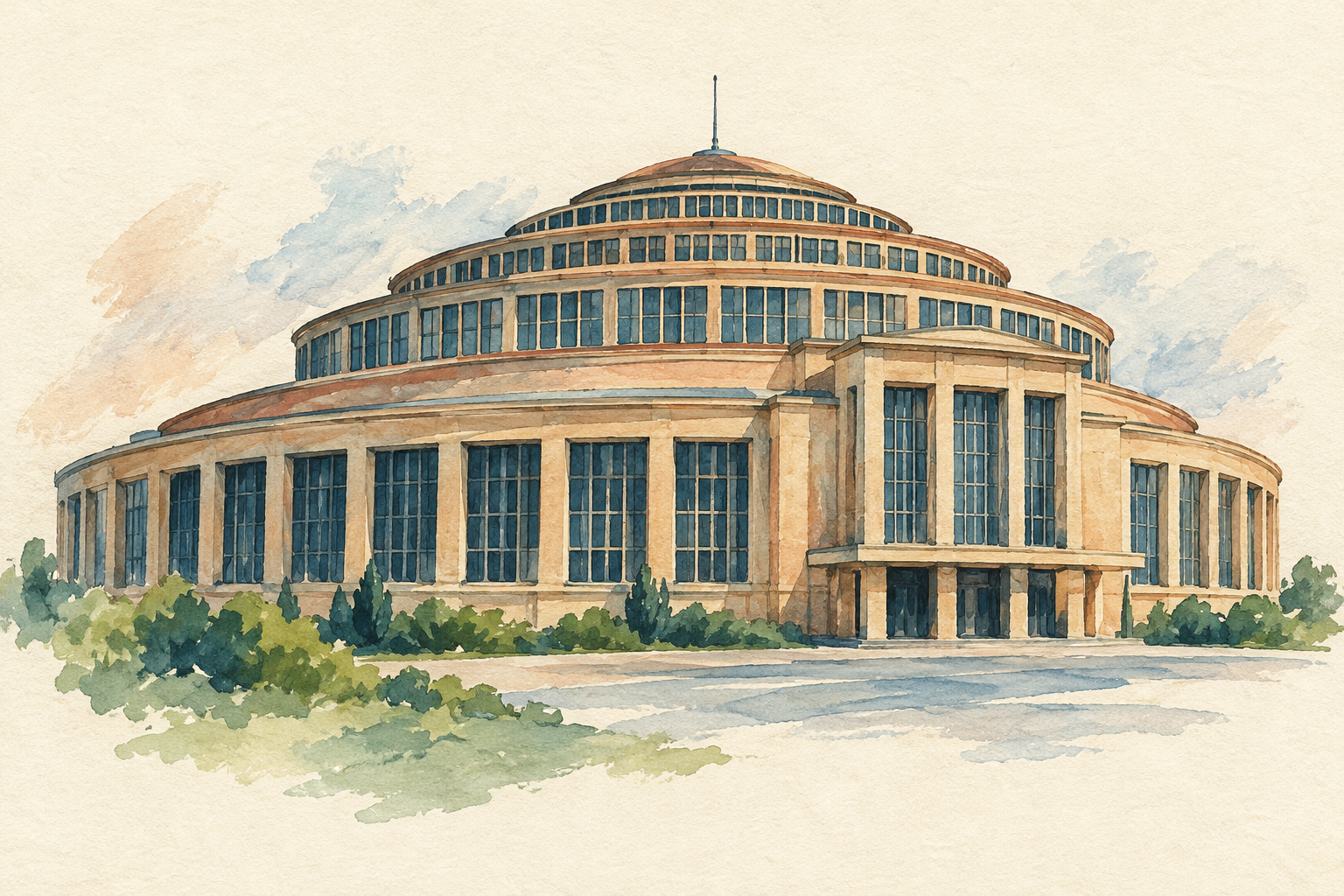
GETTING STARTED
Rynek–Plac Solny is convenient for historic walks; the central station area makes connections and arrivals easier. Across four full days, combine the centre, the Oder, Centennial Hall and Zajezdnia. First decide whether to visit the Racławice Panorama: its ticket includes permanent collections at other museums and can prevent duplicate purchases. Without it, use whichever free admission days fit your calendar.
Who it is for: Brazilians who want to choose accommodation by location, explore Wrocław on foot and public transport, and control attraction costs during four full days within a longer trip through Poland.Rynek for walking; the station for easier connections
For this itinerary, my suggestion is to stay around Rynek–Plac Solny if you want to prioritise walks through the historic centre. The square, the University and a food stop in Plac Solny form an easily understood sequence. The area around Wrocław Główny, particularly the Piłsudskiego corridor, deserves consideration if your trip through Poland involves train arrivals and departures.
The cheaper choice depends on the address and total cost of your stay, not just the neighbourhood's name. Compare both areas including the journeys you will actually make. The station combines railway access, proximity to the coach station and urban transport; Rynek makes it easy to begin and finish historic walks on foot. Neither advantage alone proves that room rates are lower.
The four days below are full sightseeing days, excluding arrival and departure. They are one part of a longer trip through Poland, with room for art, architecture, recent history and walks beside the Oder.
Use transport where it helps the itinerary
If arriving by air, check daytime city bus 106, which connects the airport to Dworzec Główny. Compare it with a private transfer if the timetable and luggage arrangements suit your journey. For those staying near the station, this arrival point also avoids having to cross to Rynek immediately.
During sightseeing, concentrate walking on the centre and Oder days. Save buses or trams mainly for Centennial Hall and Zajezdnia. The network offers single tickets and timed tickets for 24, 48, 72 and 168 hours: do not buy the longest simply because you are staying four days. Compare planned journeys and any connections; the single ticket described covers one vehicle, without transfers.
For Centennial Hall, the complex lists buses 145 or 146 from Peronowa and trams 2 or 4 from Piłsudskiego when starting at the station. Check operation on your dates and combine the museum, Pergola, a meal and the park in one outing. Avoiding an intermediate return to the centre saves a journey and makes the day flow better.
Decide on the Panorama before buying other museum tickets
The decision with the biggest impact on ticket purchases is whether to include the Racławice Panorama. The session lasts 30 minutes and offers commentary in Portuguese. After the visit, the ticket provides access to the permanent exhibitions at the National Museum, the Ethnographic Museum and the Four Domes Pavilion for the following three months.
For this itinerary, we suggest the Panorama and National Museum on day two, followed by the Pavilion on day three. You can then take advantage of two included admissions without buying those tickets again. The Ethnographic Museum is also included, but you need not feel obliged to go: choose the Panorama because you want to see the painting and the collections that fit your route.
If the Panorama does not interest you, free admission days offer another approach. A four-day period may not cover both Saturday and Tuesday; take whichever opportunity is available rather than changing the entire trip solely to pursue both free days.
- With the Panorama: visit it first, then use the inclusions for the National Museum and Four Domes Pavilion permanent exhibitions.
- Without the Panorama: try to fit the National Museum's permanent collection into Saturday or the Pavilion's into Tuesday, depending on your stay dates.
- Check temporary exhibitions separately: permanent-collection inclusion or free admission does not automatically extend to them.
Day 1: Rynek façades, Baroque art and a stop in Plac Solny
Begin at Rynek, with the Old Town Hall in the middle of the square. The suggestion is to walk around, taking in the ensemble and façades, before heading to the University Museum at pl. Uniwersytecki 1. This first day helps you find your bearings in the centre and keeps walks close to the base of travellers who chose Rynek–Plac Solny.
At the University, the reason to pay for a visit is Aula Leopoldina: the Baroque hall, built between 1728 and 1732, brings together illusionistic paintings, sculptures and decoration related to university history. It closes on Wednesdays and may have restrictions during ceremonies. If visits are unavailable, head to Bulwar Xawerego Dunikowskiego and the section beside Bastion Ceglarski, swapping the interior for the Oder landscape.
For food, the suggestion is to return to Plac Solny for a late lunch or dinner at Konspira, at number 11. The restaurant advertises Polish cuisine and a setting inspired by the anti-communist opposition and Solidarność, an interesting connection with the later Zajezdnia visit. Check service for your chosen day; the stop is included for its location and concept, without promising prices or dish availability.
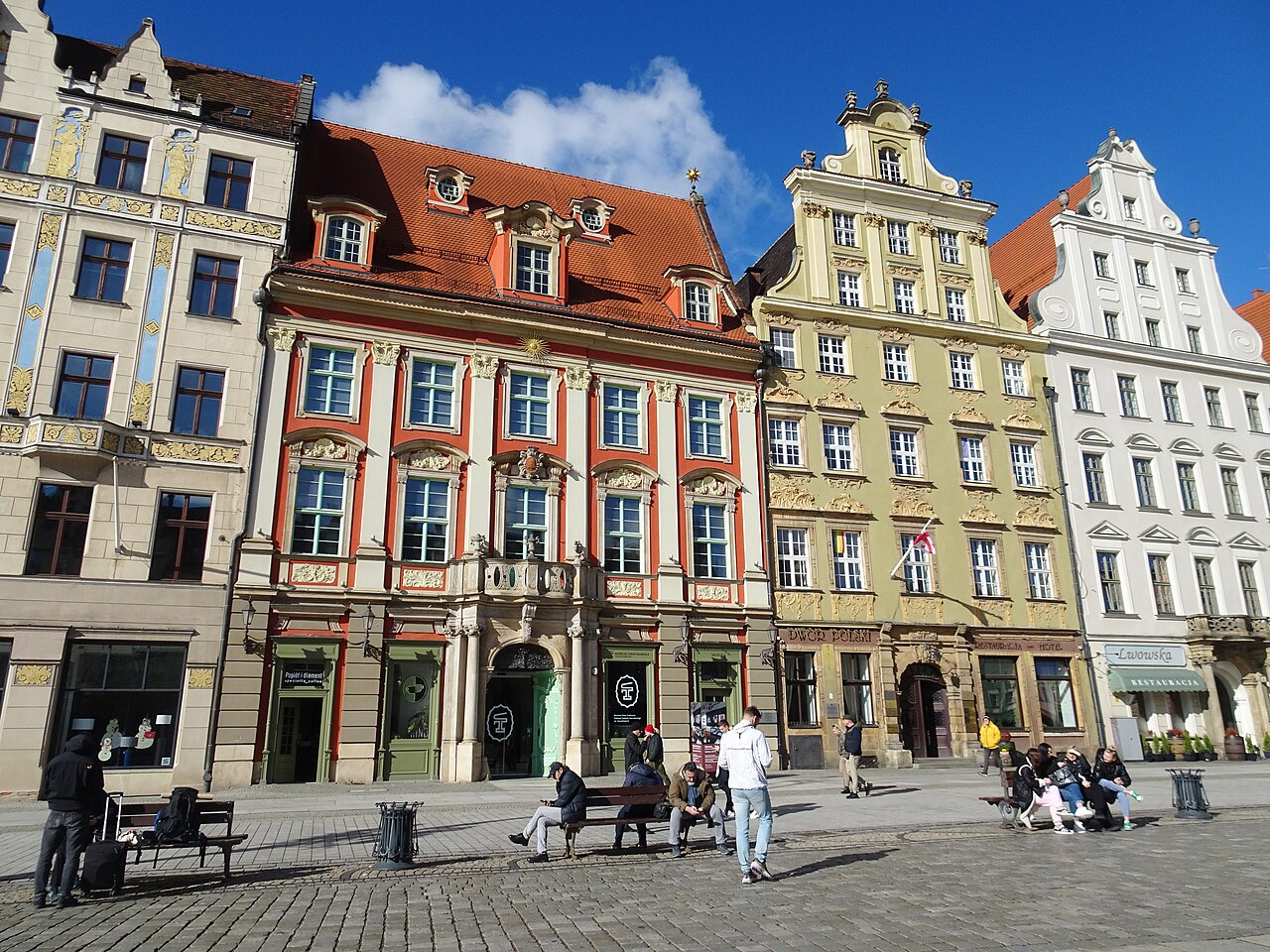
Start at Rynek to observe the gables and façades before continuing to the University and Plac Solny.
Photo: Palickap · CC BY 4.0 · 2024 · image resized.
Day 2: plan your tickets for the Panorama and National Museum
Start with a Racławice Panorama session if that is the ticket you chose. Portuguese commentary helps you follow the presentation, and this visit comes first for a practical reason: only afterwards can you use the benefit at the other museums' permanent exhibitions. Next, go to the National Museum and show your ticket without buying admission already covered.
Inside the National Museum, my suggestion is to focus on Polish art from the 17th–19th centuries and European art from the 15th–20th centuries. This selection gives the visit substance without turning the afternoon into a race through every room. The exhibition of Silesian art from the 14th–16th centuries was listed as temporarily closed when consulted on 12 October 2026.
Do the indoor visits before the riverside walk. Between October and March, the museum lists Tuesday–Friday opening from 10:00 to 16:00 and Saturday–Sunday from 10:00 to 17:00, with Mondays closed. If you skip the Panorama and are there on an open Saturday, take advantage of free admission to the permanent exhibitions.
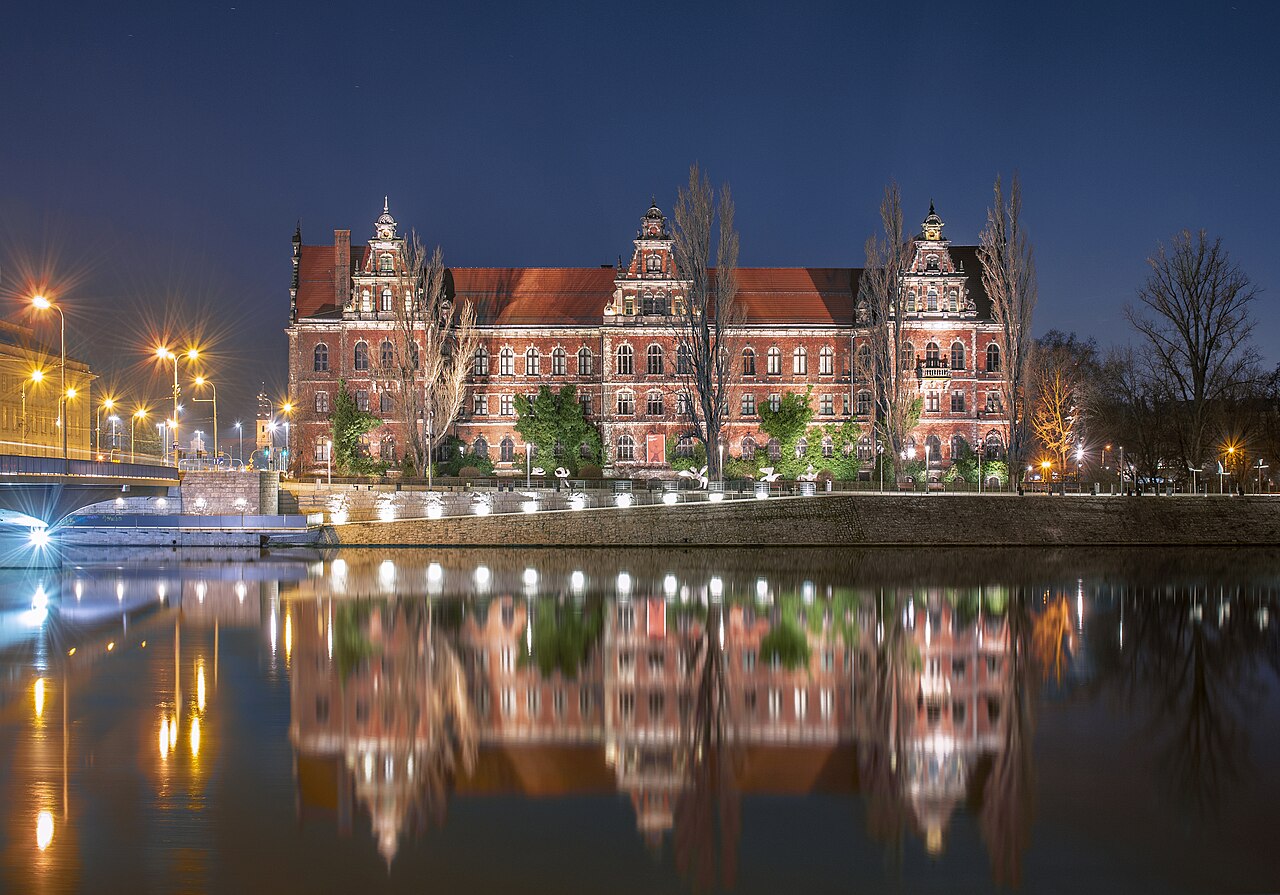
The National Museum pairs well with the Oder walk; gallery visits must follow daytime opening hours.
Photo: Marek Śliwecki · CC BY-SA 4.0 · 2020 · image resized.
Continue along the Oder to Ostrów Tumski
On leaving the National Museum, continue along Bulwar Xawerego Dunikowskiego. The official route links this walk with Hala Targowa and Bastion Ceglarski; use it to slow down after the galleries and see the city beside the water. For those who prefer walking, it is a specific alternative to adding a paid boat trip.
Head towards Tumski Bridge and finish in Ostrów Tumski. The Cathedral of St John the Baptist, the Church of St Giles and the Church of St Martin provide a set of landmarks to explore rather than relying solely on a distant view of the towers.
Entry to the cathedral is free, but sightseeing is not permitted during services. The viewpoint, chapels and other individual areas charge for access. The economical suggestion here is to see the cathedral and walk around the area, leaving the tower as a choice based on interest rather than another automatic ticket purchase.
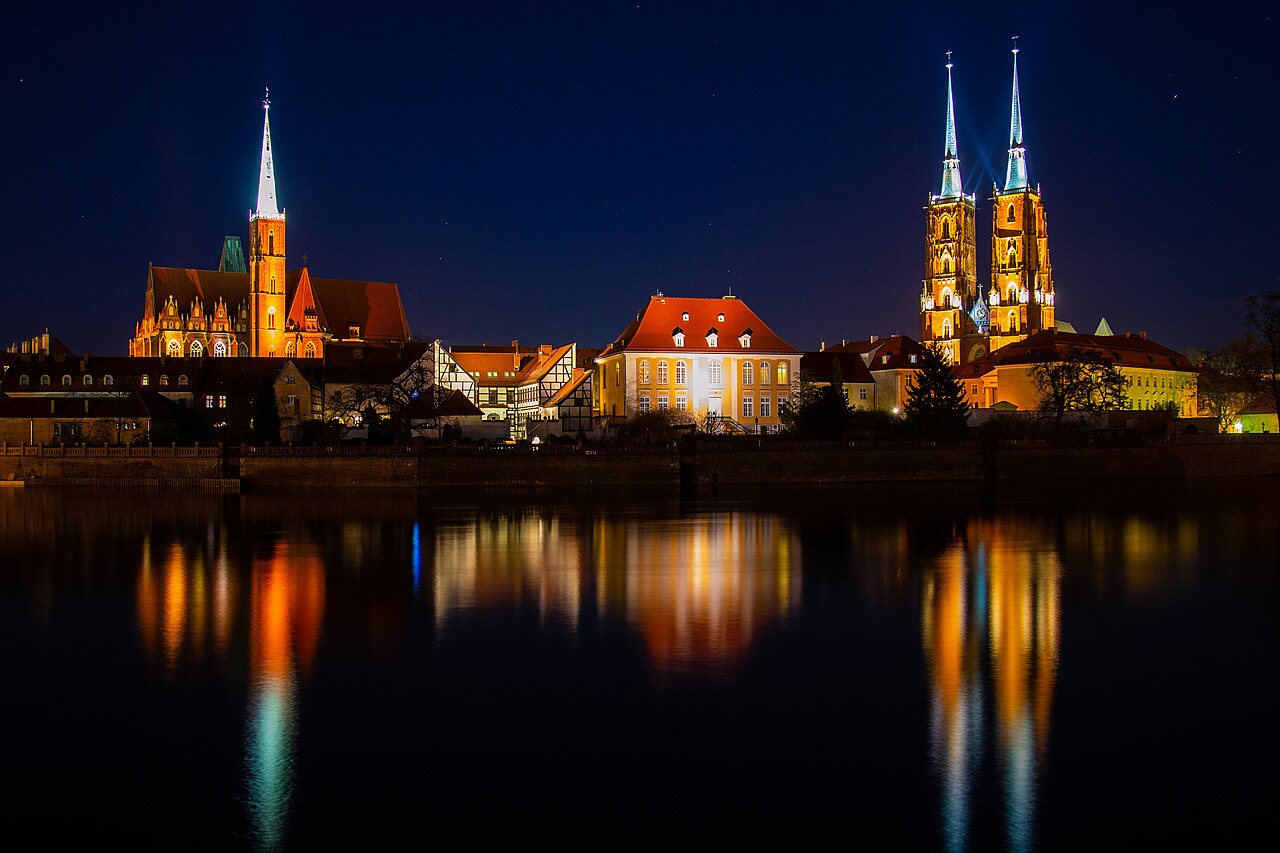
After the museums and Oder walk, Ostrów Tumski completes the route with its churches and cathedral.
Photo: Jg44.89 · CC BY 4.0 · 2015 · image resized.
Day 3: Centennial Hall and contemporary art in one outing
Devote the third outing to the Centennial Hall area. If architecture is a priority, begin at the Visitor Centre: maps, films, recordings and virtual experiences introduce the building's history and Max Berg's work. Check the ticket type before buying, as exhibition admission and the ticket adding a hall visit have different conditions; hall access depends on availability.
Then enter the neighbouring Four Domes Pavilion. Hans Poelzig's building, constructed between 1912 and 1913, houses Polish art from the second half of the 20th century and the 21st century, with artists such as Magdalena Abakanowicz, Tadeusz Kantor and Alina Szapocznikow. The collection substantially changes the outing's artistic range after the University's Baroque hall and the National Museum's historic galleries.
If you have already visited the Panorama, use the inclusion for the Pavilion's permanent collection. Without that ticket, free Tuesday admission can guide the order of your days. To control spending, prioritise the included or free collection and add the Visitor Centre only if you want to explore the architecture more deeply; Centennial Hall admission is not part of the Panorama benefit.
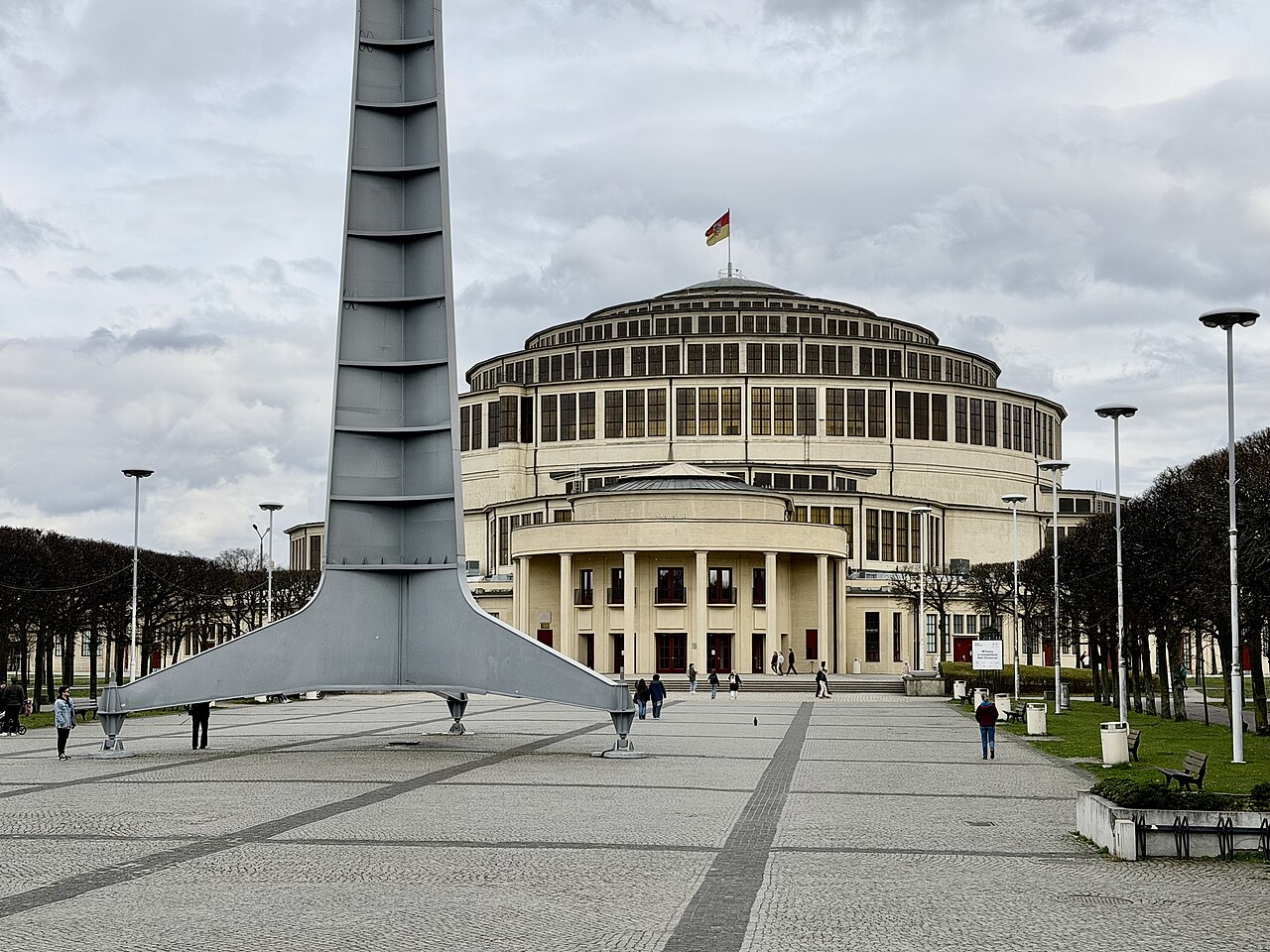
Reserve the same day for Centennial Hall, the Four Domes Pavilion and a walk through the Pergola.
Photo: Olgierd Rudak · CC BY-SA 4.0 · 2026 · image resized.
Pergola, Re:bistro and the park to complete the day
After the museum, walk through the Pergola, designed by Hans Poelzig around the artificial lake northeast of Centennial Hall. Its two rows of pillars follow a route of approximately 640 metres, described by the complex as a place to walk and rest. The walk works in its own right: this programme does not depend on a fountain show.
Take a food break at Re:bistro beside the Pergola. The complex’s official page advertises casual Polish food, snacks, lunch, coffee and desserts. This choice has a practical advantage: you remain in the area between the visits and the park, avoiding a return journey to the centre just for lunch. Check service and the menu shortly before your visit.
Continue to Szczytnicki Park, an area of approximately 100 hectares originating as an English-inspired park, with a variety of trees and shrubs. The suggestion is to finish the day's walking there. If it rains, spend longer in the Four Domes Pavilion. Szczytnicki Park and the Japanese Garden are separate spaces; do not assume that one has the other's access conditions.
Day 4: the post-war city and a walk beside the moat
On day four, go to the Zajezdnia History Centre at Grabiszyńska 184, using the Bzowa Centrum Zajezdnia stop as your public transport reference. The centre occupies a former bus depot associated with the 1980 mobilisation. It makes a good change of subject after squares, churches and art collections.
The main exhibition, Wrocław 1945–2016, explores reconstruction, population movements and the formation of the city's identity through documents, objects and audiovisual displays. Admission is paid, the centre closes on Mondays and last entry is one hour before closing. The suggestion is to visit in the morning, leaving the afternoon for an outdoor outing.
Return to the centre by public transport and head to Bastion Sakwowy, at ks. Piotra Skargi 18a. Part of the former fortifications, it is free to visit and overlooks the urban moat. Walk through the terraces and beside the moat to finish this itinerary with scenery different from the Oder waterfront.
Adjust the days without losing the route's logic
Treat the day numbers as a suggested sequence and adjust their order to the calendar. The National Museum, Four Domes Pavilion and Zajezdnia close on Mondays. If your stay includes a Monday, use it for Rynek, Bulwar Dunikowskiego, Ostrów Tumski and Bastion Sakwowy, spreading out these outdoor visits and moving museums to open days.
On Wednesday, avoid depending on Aula Leopoldina: the Oder walk is the suggested replacement. There are also two specific 2026 dates to watch: the National Museum and Pavilion list closures on 31 October and 1 November. Weekly free admission does not override these exceptions.
When changing the order, preserve the ticket logic: the Panorama should come before the permanent exhibitions you intend to visit using its benefit. If the Pavilion falls on a free Tuesday before the Panorama, use the free admission; there is no reason to repeat the visit simply to use the inclusion.
In October 2026, an evening of Portuguese-language cinema
For visitors in the city from 16 to 18 October 2026, an evening option connects with the Portuguese-speaking world: MARÉ, a film festival from Portuguese-speaking countries, at Kino Nowe Horyzonty, Kazimierza Wielkiego 19a–21. The municipal events calendar led to the programme confirmed by the cinema itself in research on 12 October 2026.
The suggestion is to choose one screening after dinner in the centre rather than trying to attend all three days. The festival adds cinema to the itinerary without requiring another daytime outing. Screenings are ticketed; check the chosen film's language and subtitles, as its connection with Portuguese-speaking countries does not guarantee full comprehension.
- 16 October 2026 at 20:00: Świst wiatru pomiędzy żurawiami, by Jeanne Waltz.
- 17 October 2026 at 20:00: short films by Gretel Marín and Ondjaki.
- 18 October 2026 at 20:00: Nocni pasażerowie, by Pedro Cabeleira.
Plan your budget and packing around your choices
Build the estimate by separating accommodation, food, transport and your chosen attractions. For transport, also count arrival and departure, even though they fall outside the four sightseeing days. For attractions, enter the Panorama once and do not add its covered permanent collections again; include the Visitor Centre, Zajezdnia, cathedral tower and cinema only if you choose them.
To arrive at a total in Brazilian reais, use prices researched for your dates and an external currency conversion, noting when it was made. The result is a planning estimate. Viajandar's calculator does not provide exchange rates or confirmed reference figures for Wrocław, so it cannot serve here as a basis for Polish prices.
Once you have chosen your outings, open Mala Inteligente and enter the trip's total duration, including arrival and departure. Use traveller profiles and the climate selection to generate the list, then review walking shoes, clothing layers and rain protection according to the forecast close to departure. The tool's climate selection helps with the checklist; it does not replace the forecast.
Which option suits you?
| Option | A good fit if… | What to consider |
|---|---|---|
| Stay around Rynek–Plac Solny | You want to walk through the historic centre and combine Rynek, the University and meals in Plac Solny. | It makes walking around the centre convenient, but you need to plan the journey with luggage from the station or airport. The location does not establish lower nightly rates. |
| Stay near Wrocław Główny, especially along Piłsudskiego | You arrive or continue by train and value proximity to the railway station, coach station and urban transport. | It simplifies intercity logistics and access to airport bus 106. For historic outings, include the walk or transport to Rynek. |
| Racławice Panorama with included permanent collections | You are interested in the panoramic painting and also intend to visit the National Museum and Four Domes Pavilion. | It avoids repurchasing admission already covered, but does not automatically include temporary exhibitions. The Panorama must precede visits using its benefit. |
| National Museum on Saturday and Four Domes Pavilion on Tuesday | You prefer the collections to the Panorama and will be in the city on free admission days. | Free admission covers permanent collections. Four consecutive days may not span both Saturday and Tuesday; use whichever fits without forcing the calendar. |
| Compare single and timed tickets based on your journeys | You will concentrate walking in the centre and use buses or trams mainly for Centennial Hall and Zajezdnia. | The single ticket described by the network does not allow transfers. A long pass may be unnecessary, while connections and multiple journeys can favour a timed ticket. |
Your itinerary, ready to save
Full day 1 — Rynek, the University and Plac Solny
Start at Rynek and view the Old Town Hall from outside. Continue to the University Museum at pl. Uniwersytecki 1 to visit Aula Leopoldina if the Baroque interior is among your priorities. Return to Plac Solny for a late lunch or dinner at Konspira, whose Polish food and setting linked to the anti-communist opposition add context to the break.
Prefer an alternative? If Aula Leopoldina is closed, especially on Wednesday, replace the interior with a walk along Bulwar Xawerego Dunikowskiego and the section beside Bastion Ceglarski. Keep the meal at Konspira.Full day 2 — the Panorama, National Museum and Oder
Book a Racławice Panorama session and visit it first. Afterwards, use the ticket inclusion at the National Museum's permanent exhibitions, choosing Polish and European art galleries. Head out along Bulwar Xawerego Dunikowskiego, continue towards Tumski Bridge and finish in Ostrów Tumski, entering the Cathedral of St John the Baptist outside services.
Prefer an alternative? If skipping the Panorama, begin directly at the National Museum; permanent collections are free on Saturdays. If the museum is closed, walk along Bulwar Dunikowskiego, Tumski Bridge and Ostrów Tumski, moving indoor visits to an open date.Full day 3 — Centennial Hall, contemporary art and park
Take public transport to the Centennial Hall complex. Begin at the Visitor Centre if you want to explore Max Berg's architecture further; then visit the Four Domes Pavilion's permanent collection using the Panorama benefit when applicable. Walk through the Pergola, stop to eat at Re:bistro and finish with a walk in Szczytnicki Park.
Prefer an alternative? If it rains, replace the final Szczytnicki Park walk with more time at the Four Domes Pavilion. If Centennial Hall's main hall is unavailable, choose between the Visitor Centre exhibition and the Pavilion collection without counting on hall access.Full day 4 — Zajezdnia and Bastion Sakwowy
Take public transport to Bzowa Centrum Zajezdnia and visit Wrocław 1945–2016 at the Zajezdnia History Centre. Return to the centre and walk through Bastion Sakwowy's terraces and beside the urban moat. If travelling between 16 and 18 October 2026, a 20:00 MARÉ screening at Kino Nowe Horyzonty can complete the evening, with a separate ticket.
Prefer an alternative? If Zajezdnia is closed or you prefer a day without that admission, start at Bastion Sakwowy and the moat. Then head to the Oder to walk along Marii i Lecha Kaczyńskich boulevard and the passage beneath Pokoju Bridge towards Bulwar Dunikowskiego.Before you go
- Allow four full sightseeing days, excluding arrival and departure from this itinerary. Fit Wrocław into the total duration of your Poland trip.
- Compare the accommodation's exact address with Rynek, Wrocław Główny and the stops you will use. Add accommodation and transport costs before choosing an area.
- Check airport bus 106 and urban routes and timetables for your travel dates; do not assume a fixed journey time.
- Before buying transport tickets, check each type's validity. The single ticket described by the network covers one journey in one vehicle without transfers; an electronic ticket bought on board requires no additional validation.
- If using Panorama inclusions, visit it first and keep the ticket for the National Museum and Four Domes Pavilion permanent collections. Check any temporary exhibition separately.
- The National Museum, Four Domes Pavilion and Zajezdnia close on Mondays. Aula Leopoldina lists Wednesday closures and may have restrictions during academic ceremonies.
- The National Museum and Four Domes Pavilion list closures on 31 October and 1 November 2026. The National Museum's exhibition of 14th–16th-century Silesian art was listed as temporarily closed when consulted.
- Confirm the type of Centennial Hall visit: the Visitor Centre exhibition and access to the main hall have different conditions, and hall access depends on availability.
- Check service at Konspira and Re:bistro shortly before your visit. The sources do not guarantee a table, price or availability of a particular item.
- For MARÉ, from 16 to 18 October 2026, check tickets, language and subtitles for the 20:00 screening on Kino Nowe Horyzonty's website.
- Build the budget using prices researched for your dates and an identified external currency conversion. Treat the total in reais as an estimate, not a quote.
- Use Mala Inteligente with the total trip duration and review the list according to your outings and the forecast close to departure.
Questions to help you decide
Is it better to stay at Rynek or near the central station?
For this itinerary, Rynek–Plac Solny suits travellers who want to walk through the historic centre. The area around Wrocław Główny, particularly Piłsudskiego, favours train arrivals and departures and access to urban transport. Compare accommodation totals and journeys: the evidence does not establish that either area is always cheaper.
Do the four days include arrival and departure?
This itinerary allows four full sightseeing days, excluding arrival and departure, within a longer trip through Poland. It combines the historic centre, Oder, museums, Centennial Hall and recent history, without trying to cover all of Wrocław or define an ideal length of stay.
What does a Racławice Panorama ticket include?
The ticket allows visits to the permanent exhibitions at the National Museum, Ethnographic Museum and Four Domes Pavilion in the three months following the Panorama visit. It does not automatically include temporary exhibitions. In this itinerary, its main use is at the National Museum and Pavilion; you need not add another museum simply because it is included.
Which free admissions are confirmed?
Entry to the Cathedral of St John the Baptist is free, subject to services; the viewpoint and individual spaces charge admission. Bastion Sakwowy is free to visit. The National Museum's permanent collections are free on Saturdays, and the Four Domes Pavilion's permanent collection on Tuesdays, according to the opening calendar.
Can this itinerary be done without a car?
The itinerary was organised around walks in the centre and public transport to Centennial Hall and Zajezdnia. The airport lists daytime route 106 to Dworzec Główny. Check routes and timetables for your travel dates before choosing tickets.
How can the itinerary be adapted if it includes a Monday?
Use Monday for Rynek, Bulwar Xawerego Dunikowskiego, Ostrów Tumski and Bastion Sakwowy, spreading the walks according to your pace. The National Museum, Four Domes Pavilion and Zajezdnia close on Mondays. Keep the Panorama before museums where you intend to use included admission.
Ready to start planning?
Turn the itinerary's walks and visits into a checklist in Mala Inteligente ↗A preview of your next trip
See the destination on video, then return to the itinerary to plan your trip at your own pace. Video in Portuguese.
Sources and editorial review
This is a researched guide, not a personal account of a visit. The itinerary suggestions are editorial recommendations. Confirm opening arrangements, prices and conditions close to your trip.
- VisitWrocław — Rynek and the Old Town Hall · checked 2026-10-12
- Wrocław Airport — public transport access · checked 2026-10-12
- VisitWrocław — train arrivals and central station · checked 2026-10-12
- VisitWrocław — public transport and ticket types · checked 2026-10-12
- VisitWrocław — Aula Leopoldina and the University Museum · checked 2026-10-12
- Konspira — official restaurant, location and contact · checked 2026-10-12
- VisitWrocław — Ostrów Tumski and the Cathedral of St John the Baptist · checked 2026-10-12
- Wrocław National Museum — visits, free admission and calendar · checked 2026-10-12
- National Museum — exhibitions and partial closure notice · checked 2026-10-12
- Racławice Panorama — Portuguese session and one ticket for four museums · checked 2026-10-12
- Four Domes Pavilion — visits and free Tuesdays · checked 2026-10-12
- Centennial Hall — Four Domes Pavilion architecture and collection · checked 2026-10-12
- Centennial Hall — Visitor Centre and visit types · checked 2026-10-12
- Centennial Hall — bus and tram access · checked 2026-10-12
- Centennial Hall — Pergola · checked 2026-10-12
- Centennial Hall — Szczytnicki Park · checked 2026-10-12
- Centennial Hall — Re:bistro · checked 2026-10-12
- VisitWrocław — Zajezdnia History Centre · checked 2026-10-12
- VisitWrocław — Bastion Sakwowy · checked 2026-10-12
- VisitWrocław — route along the Oder's banks · checked 2026-10-12
- Wrocław City Council — Wrocław GO calendar · checked 2026-10-12
- Kino Nowe Horyzonty — MARÉ 2026 · checked 2026-10-12
- Viajandar — Mala Inteligente · checked 2026-10-12
- Viajandar — trip calculator and limits of the version consulted · checked 2026-10-12