France · Strasbourg, Alsace, France
Gare or Grande Île: where to stay and how to spend four days in Strasbourg without a car
Gare or Grande Île? Compare bases for four days in Strasbourg without a car, with free visits, museums chosen by interest and Alsatian food.
GETTING STARTED
Grande Île is convenient for walks in the centre; Gare makes arrival with luggage and transport connections easier. In four full days, combine the Cathedral, Petite France, Neustadt and the European quarter, choosing museums according to your interests and enjoying visits with confirmed free admission.
Who it is for: Brazilians wanting to explore Strasbourg without a car, control spending and combine architecture, museums, gardens and Alsatian food in four full sightseeing days.Gare or Grande Île? Choose by the journey you want to make easier
For this itinerary, we suggest staying on Grande Île if you want to prioritise walks around Notre-Dame Cathedral and Petite France. The Gare area becomes more attractive when making arrival, departure and journeys with luggage easier matters most. The station is within walking distance of the centre and offers tram and bus connections: both bases let you organise the trip without a car.
When choosing, open a map of the accommodation’s exact address and compare the routes to the station, cathedral and Petite France. Then check the total stay for the same dates and conditions. It is not possible to say that staying near Gare costs less; the established advantage here is the connection to transport.
The four days below are full sightseeing days within a longer European trip. Arrival and departure are excluded. This selection focuses on Strasbourg, with time to look at architecture, enter museums that interest you and take breaks, without adding Alsace day trips.
Plan your walks before choosing transport tickets
The first possible saving is to organise journeys before buying transport tickets. Keep the Cathedral and Œuvre Notre-Dame together; on another day, follow Petite France, Ponts Couverts, Barrage Vauban and MAMCS in the same sequence. For the European quarter, compare the route from your accommodation and group the tram journeys that make sense.
CTS offers single tickets, 24H SOLO, 24H TRIO and 72H SOLO, as well as Alsa+ options with different coverage. Count the trips you actually intend to make before choosing: four days in the city do not mean four days using transport constantly. Also check each ticket’s coverage without assuming that an urban ticket includes the airport train.
If you arrive by air, first check the railway connection to the central station; there is a covered pedestrian passage between the terminal and station. In the CTS app, pay attention to QR Codes bought through Départ Immédiat: validity begins on payment. Validation is automatic on trams but required on conventional buses; Badgéo via NFC follows a different procedure.
Day 1: from the cathedral façade to the museum’s sculptures
Begin the first day at Notre-Dame Cathedral: observe the façade before entering and pay attention to the medieval stained glass. The standard visit is free, without booking, through the south portal. According to the hours consulted on 15 October 2026, entry is Monday to Saturday, 08:30–11:15 and 12:45–17:45; Sundays and feast days, 14:00–17:15. Allow for the midday closure when planning.
Consider the extras separately. The astronomical clock presentation requires a ticket, and the platform should be assessed on its own. If you want city views without adding that admission, leave the free Barrage Vauban terrace for the second day.
After the cathedral, we suggest crossing to Musée de l’Œuvre Notre-Dame at 3 place du Château. Sculptures from the monument, stained glass and medieval and Renaissance art build on what you have just seen. The museum closes on Mondays and divides weekday opening into two periods. If you already planned to climb to the platform, check the two-week reduced-rate offer for visitors presenting a recent platform ticket.
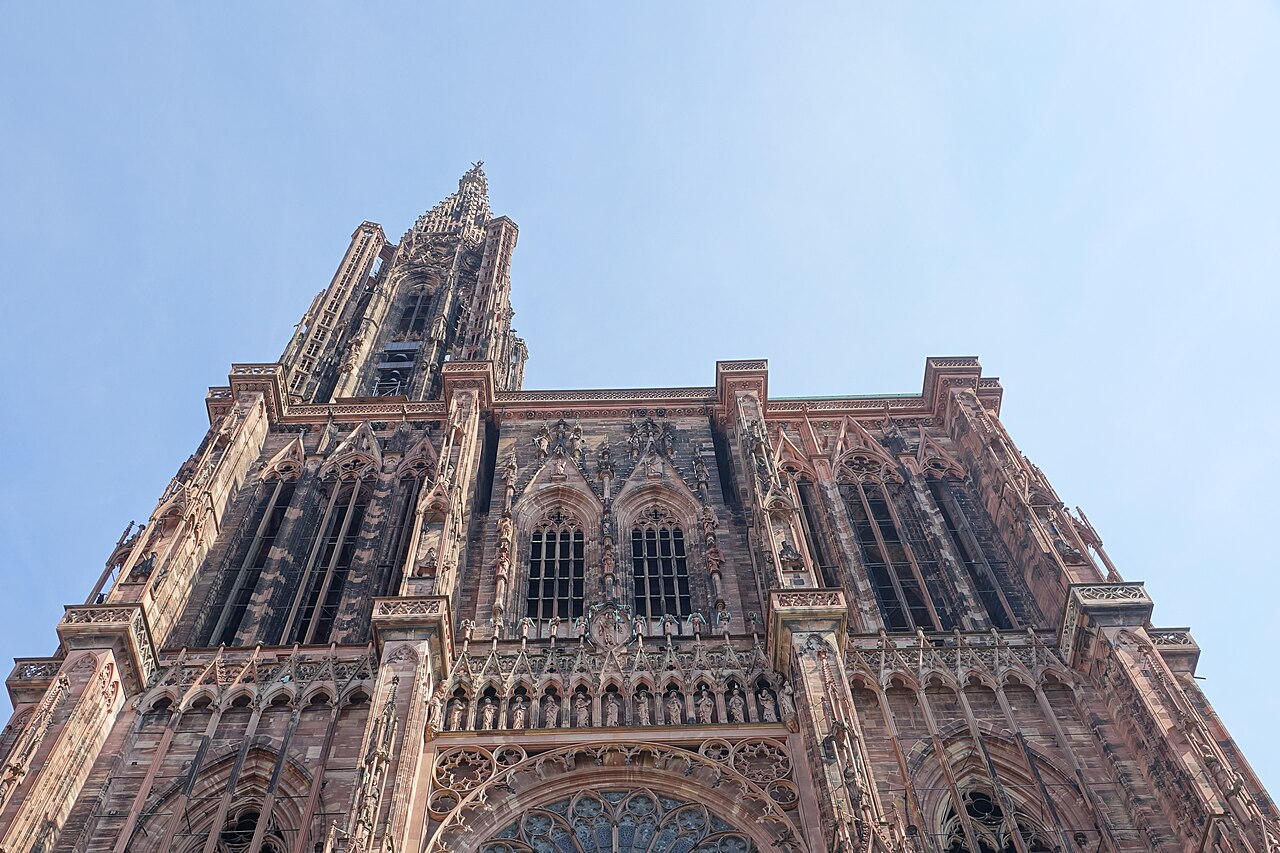
Look up before entering: the façade opens the outing that continues among stained glass and sculptures in the neighbouring museum.
Photo: Gzen92 · CC BY-SA 4.0 · 2019 · image resized.
Two exhibitions along the route, on the right dates
For trips between 16 October 2026 and 11 April 2027, Musée de l’Œuvre Notre-Dame hosts Bâtir · Préserver · Transmettre, an exhibition about the 800 years of the Œuvre Notre-Dame Foundation. It is an additional reason to choose the museum: after exploring the cathedral, you can examine the construction and preservation work that sustains it. When consulted on 15 October, opening was still scheduled for the following day.
At Barrage Vauban, Exposition de photographies inédites d’opérations menées par la Ville is confirmed from 1 to 25 October 2026 as part of Journées de l’Architecture. Admission is free, and photographs of projects and urban interventions add another perspective to your walk through the historic city.
We suggest fitting these exhibitions into the days already dedicated to their venues, without creating extra journeys. The official calendar was consulted on 15 October 2026; if your trip falls outside these periods, keep the outings and consult the programme for your own dates.
Day 2: Petite France canals and views from Barrage Vauban
On the second day, begin on rue du Bain-aux-Plantes and along the Petite France canals, including pont du Faisan. The appeal of this walk is following the water and observing the houses from different angles. Our sequence keeps the lunch break on the same street and continues afterwards towards Ponts Couverts.
From Ponts Couverts, continue to Barrage Vauban and visit its panoramic terrace, which is free to enter and explore independently. Here you can see the city and canals from above without adding another ticket to the day. Check access hours before going; free admission does not mean it is always open.
From there, you can finish at MAMCS if you want a museum visit or return to the canals via pont du Faisan. The second option gives the afternoon more outdoor time and dispenses with modern art admission. You can choose according to your interests without feeling obliged to enter every museum on the route.
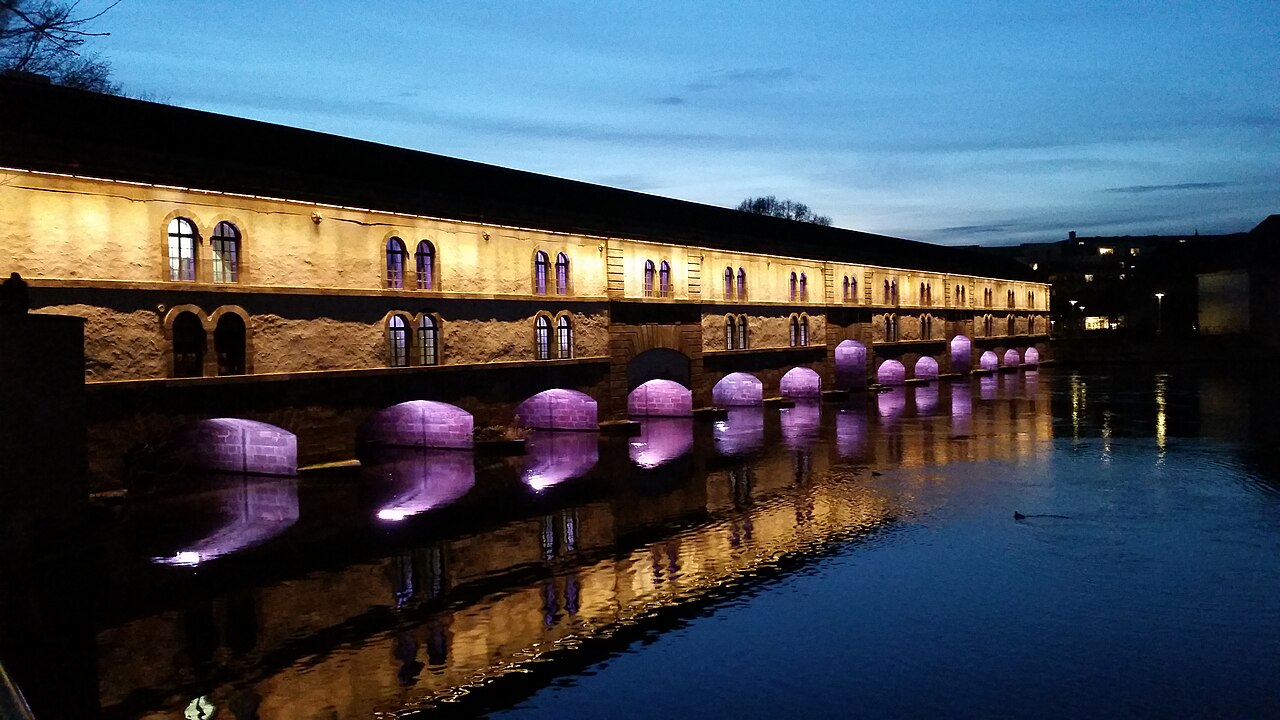
Between Ponts Couverts and MAMCS, Barrage Vauban deserves a stop of its own. This image shows its exterior at dusk.
Photo: Aline Vidal · CC BY-SA 4.0 · 2017 · image resized.
A break for Alsatian food at Maison des Tanneurs
Our lunch suggestion in Petite France is Maison des Tanneurs at 42 rue du Bain-aux-Plantes. The restaurant fits naturally between the canal walk and the continuation to Ponts Couverts, making the meal a chance to experience Alsatian cuisine along the way.
The restaurant’s website presents choucroute as a speciality and lists service from Tuesday to Saturday. Check service and reservations for your date without counting on a particular dish before consulting the offering. There is no basis for classifying the restaurant as cheap: assess the expense as a gastronomic choice within the itinerary.
If this meal is a priority, schedule your Petite France day between Tuesday and Saturday and arrange the other outings around it. That way you avoid arriving expecting lunch on a day with no advertised service.
Which museum should you pay to visit?
If your budget covers just one museum, start with the subject that appeals most. Œuvre Notre-Dame is our choice for those wanting to deepen the cathedral visit. MAMCS is better suited to those who prefer Impressionism, abstraction and Surrealism, with artists such as Jean Arp, Max Ernst and Kandinsky.
MAMCS charges adult admission and fits at the end of the Barrage Vauban outing. If you need to arrive by tram, the published reference is line B, Musée d’Art Moderne stop. Choosing this museum lets the first day focus more closely on the standard cathedral visit and walks.
For drawing and illustration, consider Musée Tomi Ungerer at Villa Greiner, 2 avenue de la Marseillaise. The displays rotate, and the collection also includes satire and erotic works: the whole visit should not be treated as a children’s activity. All three museums close on Mondays, so schedule them on the other days and check their hours before buying tickets.
Day 3: walk from Place de la République to Palais universitaire
On the third day, change the scene: leave the canals and begin at Place de la République in front of Palais du Rhin. Neustadt brings together large squares, tree-lined avenues and different architectural styles in an ensemble recognised as World Heritage.
We suggest observing the exteriors around the square and following avenue de la Liberté towards Palais universitaire. The route provides space to compare façades and appreciate this part of the city’s scale without depending on interior tickets. Do not count on unrestricted access to buildings.
Continue to the Botanical Garden in the afternoon as the next part of the walk. If you prefer Musée Tomi Ungerer, visit it as you pass Place de la République, before following the avenue, to avoid retracing the route just to enter the museum.
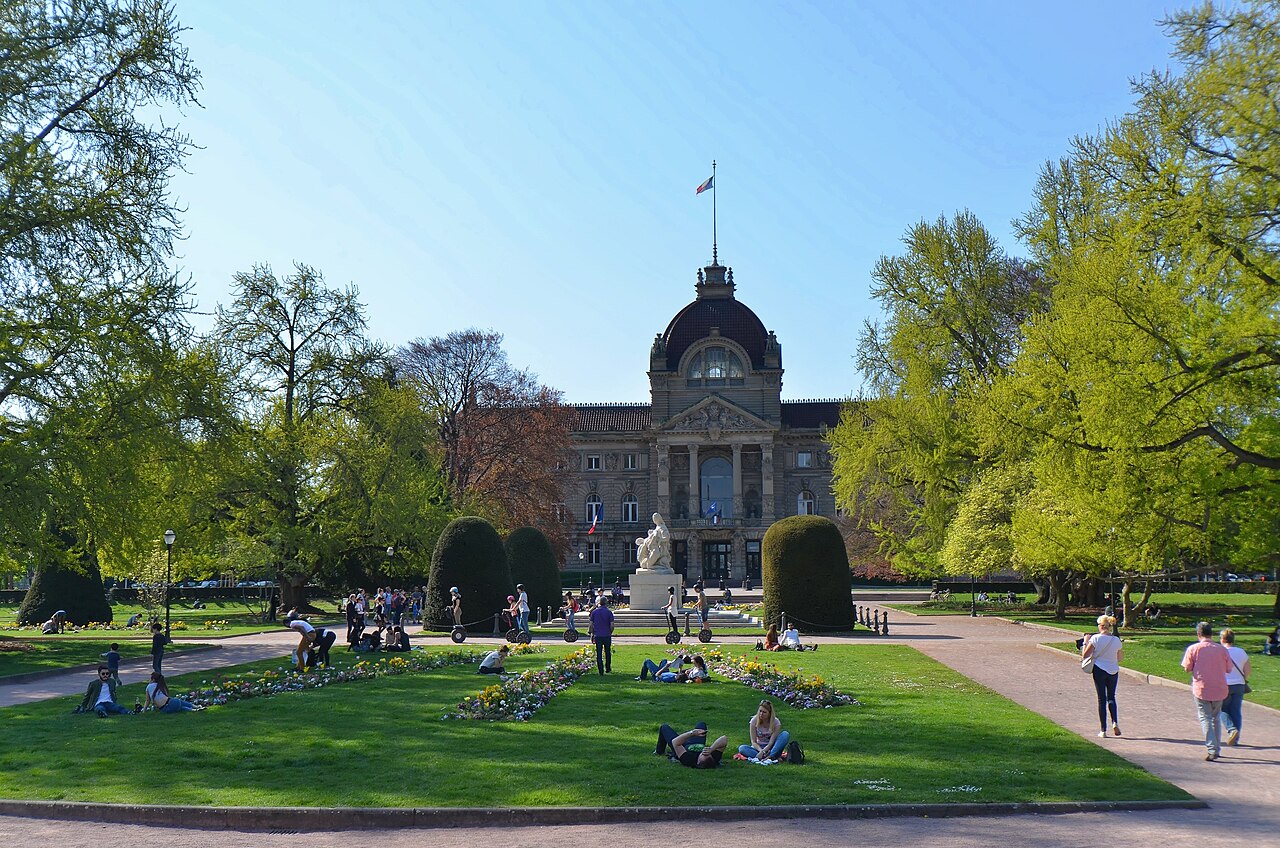
Place de la République is the starting point for the avenues and monumental architecture of Neustadt.
Photo: Morio60 · CC BY-SA 2.0 · 2019 · image resized.
An afternoon in the Botanical Garden, with alternatives if it is closed
The university’s Botanical Garden is free to enter via allée Anton De Bary. After exploring Neustadt’s architecture, we suggest the self-guided arboretum route: continue among trees in a setting different from the avenues. There are also routes devoted to mountain plants, ferns and useful plants.
Regular published October hours are 14:00–18:00; in November and December, 14:00–16:00. There is an annual winter closure and exceptional closures. For public transport users, the indicated stop is Université.
Note the exception: the garden will be completely closed on 17 October 2026. There is also a seasonal greenhouse closure notice for the cold period of 2026/2027. That Saturday, Musée Tomi Ungerer is confirmed open 10:00–18:00 and offers a concrete paid alternative. To keep the day without that admission, extend the exterior walk around Place de la République and Palais universitaire.
Day 4: European Parliament and an Orangerie walk
Devote the fourth day to the European Parliament and Parc de l’Orangerie. Outside plenary sessions, the parliamentary visit is free and includes the chamber, Parlamentarium Simone Veil and exhibitions. Resources are available in 24 languages, and the indicative duration is around one hour. It is a chance to add European institutional life to the architecture and museum itinerary.
Individual booking is optional, but bring a valid physical identity document and check the calendar: the page lists Sunday closures, exceptions in 2026 and different arrangements during plenary sessions. From Monday to Friday there is a café in the visitor area; we suggest taking a break there before continuing to the park, when the service is available.
At the Orangerie, explore the French-style and English landscaped areas, pass the lake and view Pavillon Joséphine from outside. The park complements the European quarter and gives the afternoon a different pace from a museum visit. For transport, the published reference is line E, Droits de l’Homme stop; check the connection from your accommodation.
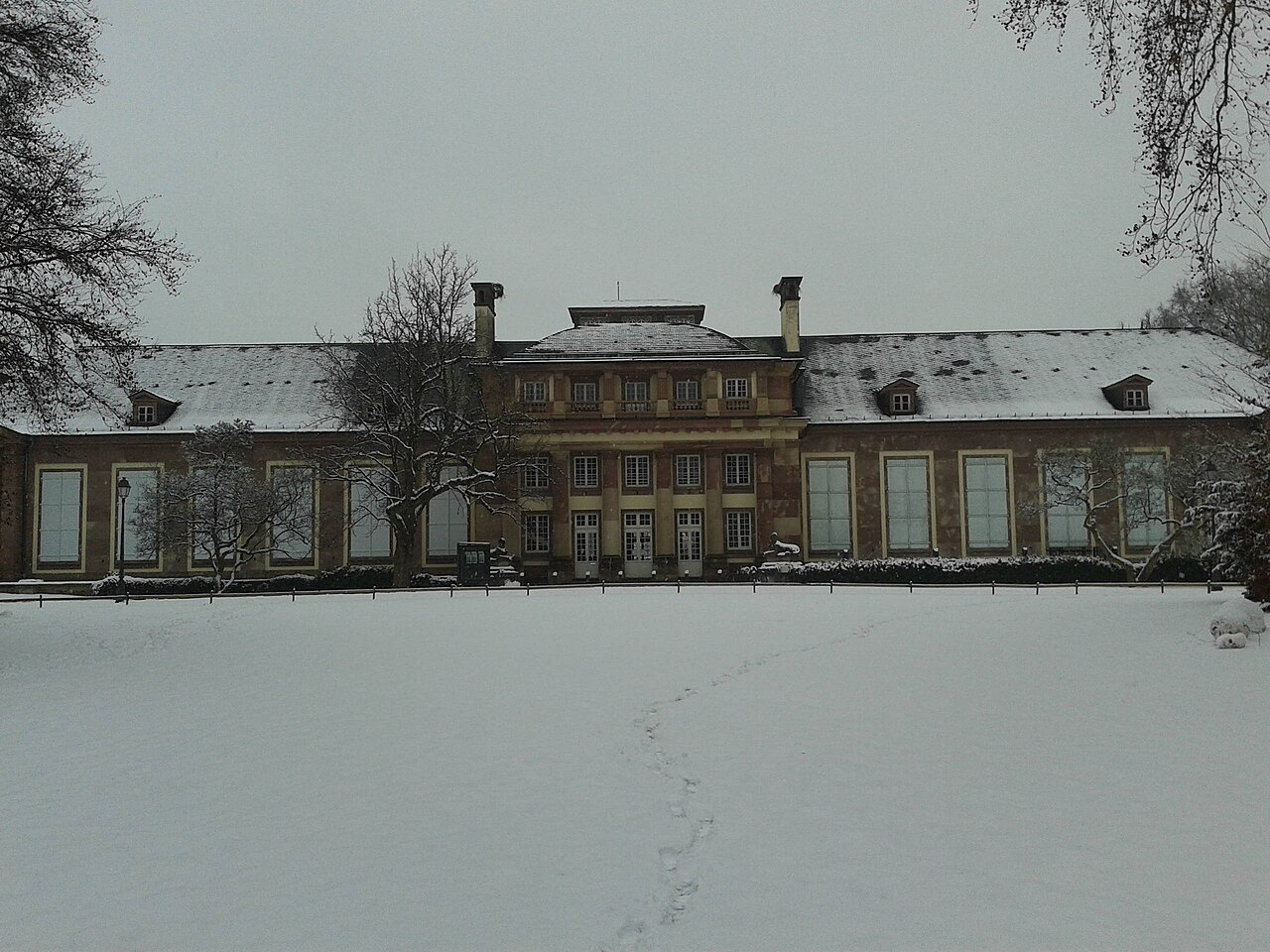
Pavillon Joséphine forms part of the Orangerie walk. This photograph’s winter landscape does not represent October conditions.
Photo: Gzen92 · CC BY-SA 4.0 · 2017 · image resized.
Adjust the days to the calendar and turn the itinerary into a checklist
Before finalising the order of the days, schedule three things: museum visits on days other than Monday, Maison des Tanneurs between Tuesday and Saturday, and Parliament on a date allowed by its calendar. If your four days include a Monday, use it for the Neustadt walk or the parliamentary visit, if the calendar permits. Check the garden and museum arrangements separately.
To organise the budget, gather the actual accommodation total for your dates, chosen tickets, necessary transport and the meal at Maison des Tanneurs. The reference values in reais in Viajandar’s calculator represent neither Strasbourg prices nor international quotations; for that reason, the most useful tool here is Mala Inteligente.
Use Mala to generate a checklist with the full trip duration, including arrival and departure, and select the climate and traveller profiles. Then review the list with Petite France walks, gardens and cultural visits in mind, adding the physical identification required by Parliament. The tool does not automatically consult Strasbourg’s weather forecast.
Which option suits you?
| Option | A good fit if… | What to consider |
|---|---|---|
| Accommodation near Gare | You arrive or depart by train and want to make travelling with luggage easier. | The station has tram and bus connections and is within walking distance of the centre. Compare your accommodation’s exact address with the sights; there is no evidence that nightly rates are lower. |
| Accommodation on Grande Île | You want to prioritise Cathedral and Petite France walks. | It is convenient for the first two days. You still need to plan the journey between the station and accommodation and travel to the European quarter. |
| Pay for Musée de l’Œuvre Notre-Dame | You enjoy sculpture and stained glass, and want to understand the cathedral better. | It is the most direct addition to day one. It closes on Mondays, and the 800th-anniversary exhibition runs for a fixed period. |
| Pay for MAMCS | You prefer Impressionism, abstraction and Surrealism. | It fits after Barrage Vauban. It closes on Mondays and adds an indoor visit to a day with plenty of walking. |
| Pay for Musée Tomi Ungerer | You enjoy drawing and illustration, or need an alternative to the Botanical Garden. | Displays from the collection rotate. The museum closes on Mondays and includes adult themes; it is not entirely a children’s museum. |
| Cathedral, Barrage Vauban terrace, Botanical Garden and European Parliament | You prioritise confirmed free activities. | Each visit has its own conditions: the garden has seasonal and exceptional closures, and Parliament visits depend on its calendar. |
Your itinerary, ready to save
Day 1 — Cathedral and medieval art
Start with the standard visit to Notre-Dame Cathedral within its access hours. Observe the stained glass and then continue to Musée de l’Œuvre Notre-Dame on place du Château if this is your chosen ticket. Between 16 October 2026 and 11 April 2027, include Bâtir · Préserver · Transmettre. The museum closes on Mondays.
Prefer an alternative? If Musée de l’Œuvre Notre-Dame is closed or outside your budget, spend longer observing the cathedral façade and walk around Petite France, including rue du Bain-aux-Plantes and pont du Faisan.Day 2 — Petite France, Alsatian food and Barrage Vauban
Walk along rue du Bain-aux-Plantes and pont du Faisan. Our lunch suggestion is Maison des Tanneurs, which lists Tuesday-to-Saturday service. Then continue to Ponts Couverts and Barrage Vauban’s free terrace. Finish at MAMCS if modern art is your priority and the day is not Monday.
Prefer an alternative? If you prefer to skip MAMCS, return to the Petite France canals via pont du Faisan. From 1 to 25 October 2026, add the free photography exhibition at Barrage Vauban without changing area.Day 3 — Neustadt and Botanical Garden
Begin at Place de la République, observe Palais du Rhin from outside and follow avenue de la Liberté towards Palais universitaire. Leave the Botanical Garden for the afternoon, entering via allée Anton De Bary. Choose the self-guided arboretum route and check closure notices before leaving.
Prefer an alternative? Replace the Botanical Garden with Musée Tomi Ungerer if you prefer illustration or find the garden closed. On 17 October 2026, this swap is especially useful: garden closure and museum opening from 10:00 to 18:00 are confirmed.Day 4 — European Parliament and Orangerie
Set aside the morning for the type of Parliament visit available on your date. Outside plenary sessions, the visit includes the chamber, Parlamentarium Simone Veil and exhibitions. From Monday to Friday, you can take a break at the café in the visitor area. Afterwards, walk through Parc de l’Orangerie, passing the lake and the outside of Pavillon Joséphine.
Prefer an alternative? If Parliament is not receiving visitors on your date, visit Parc de l’Orangerie and swap the parliamentary visit with another day’s Neustadt walk. If the swap does not fit the calendar, keep the park and add Place de la République without counting on Parliament access.Before you go
- Allow four full sightseeing days and set aside arrival and departure time separately.
- Compare the exact addresses of Gare and Grande Île accommodation, plus the total price and booking conditions for the same dates.
- If arriving through the airport, consult train times to the central station before booking a transfer.
- Count transport journeys and check CTS ticket coverage; do not assume the airport rail connection is included.
- In the CTS app, buy a Départ Immédiat QR code ticket only when you are ready to use it: validity begins on payment. Check the validation procedure for your transport mode and ticket type.
- Avoid scheduling Œuvre Notre-Dame, MAMCS or Tomi Ungerer on Monday. Also check each museum’s opening periods.
- Check the cathedral access window and treat the platform and clock presentation as separate activities.
- For lunch at Maison des Tanneurs, check service and reservations on the official website; the page consulted lists Tuesday-to-Saturday service.
- Do not schedule the Botanical Garden for 17 October 2026. Check seasonal notices and do not count on greenhouse access.
- Before Parliament, check plenary sessions, calendar exceptions and the valid physical identification requirement.
- Use exhibitions only on confirmed dates: Barrage Vauban until 25 October 2026; Bâtir · Préserver · Transmettre from 16 October 2026 to 11 April 2027.
- Generate a Mala Inteligente checklist for the full trip duration and review it for walks, parks and cultural visits.
Questions to help you decide
Is it better to stay near Gare or on Grande Île?
For this itinerary, we suggest Grande Île if your priority is walking straight out to the central sights. The Gare area makes sense when arrival, departure and luggage weigh more heavily in the choice. Compare rates for the same dates: the sources do not establish that one area is cheaper.
Do the four days include arrival and departure?
This itinerary allows four full days within a longer trip through Europe, with arrival and departure counted separately. It combines the historic centre, Neustadt and the European quarter, without trying to see all of Strasbourg or include other destinations in Alsace.
If I pay for just one museum, which should I choose?
Choose Musée de l’Œuvre Notre-Dame if the cathedral, stained glass and medieval art arouse the most curiosity. Prefer MAMCS for Impressionism, abstraction and Surrealism. Tomi Ungerer is the most specific choice for drawing and illustration.
Should I buy a transport pass as soon as I arrive?
Not automatically. CTS offers single tickets and 24- and 72-hour options, among others. As the central outings have been grouped for walking, count your planned journeys and compare conditions before buying.
Is the entire cathedral visit free?
The standard visit has free access without booking during the hours published by the parish. This does not automatically include the platform or astronomical clock presentation, which should be treated separately.
Can I visit the Botanical Garden any day in October?
No. Complete closure is announced for 17 October 2026, in addition to annual winter closure and greenhouse notices for the cold period of 2026/2027. On the 17th, Musée Tomi Ungerer is confirmed open 10:00–18:00 and works as a paid alternative.
Do I need to book the European Parliament visit?
Visits outside plenary sessions are free, and individual booking is optional. Bring a valid physical identity document and check the calendar: there are Sunday closures, exceptions and different arrangements during plenary sessions.
Ready to start planning?
Turn outings into an entire-trip checklist in Mala Inteligente ↗A preview of your next trip
See the destination on video, then return to the itinerary to plan your trip at your own pace. Video in Portuguese.
Sources and editorial review
This is a researched guide, not a personal account of a visit. The itinerary suggestions are editorial recommendations. Confirm opening arrangements, prices and conditions close to your trip.
- Strasbourg Tourisme — train arrival · checked 2026-10-15
- Aéroport de Strasbourg — rail connection · checked 2026-10-15
- CTS — occasional tickets · checked 2026-10-15
- CTS — app activation and validation · checked 2026-10-15
- Cathédrale Notre-Dame — access and hours · checked 2026-10-15
- Strasbourg Tourisme — cathedral features · checked 2026-10-15
- Musées de Strasbourg — Musée de l’Œuvre Notre-Dame · checked 2026-10-15
- Musées de Strasbourg — the Foundation’s 800th-anniversary exhibition · checked 2026-10-15
- Strasbourg Tourisme — Petite France and bridges · checked 2026-10-15
- Maison des Tanneurs — official restaurant · checked 2026-10-15
- Office de Tourisme du Pays de Barr — free Vauban terrace · checked 2026-10-15
- Strasbourg Tourisme — Musée d’Art Moderne et Contemporain · checked 2026-10-15
- Strasbourg Tourisme — Neustadt · checked 2026-10-15
- Université de Strasbourg — Botanical Garden access and hours · checked 2026-10-15
- Université de Strasbourg — free entry and self-guided routes · checked 2026-10-15
- Université de Strasbourg — current Botanical Garden notices · checked 2026-10-15
- European Parliament — non-plenary visit · checked 2026-10-15
- Strasbourg Tourisme — Parc de l’Orangerie · checked 2026-10-15
- Strasbourg Tourisme — official programme · checked 2026-10-15
- Ville de Strasbourg — free Vauban exhibition · checked 2026-10-15
- Strasbourg Tourisme — Musée Tomi Ungerer · checked 2026-10-15
- Viajandar — Mala Inteligente · checked 2026-10-15
- Viajandar — calculator limitations for this international destination · checked 2026-10-15