Norway · Oslo, Norway
Oslo without a car: where to stay and what to do in four days
Where to stay in Oslo and how to plan four days without a car, with free sights, museums, lunch at Mathallen and transport options.
GETTING STARTED
Start the accommodation search around Oslo S and Kvadraturen, or compare Grünerløkka and Vulkan if food and neighbourhood life are priorities. Across four full days, combine Bjørvika and Akershus, the National Museum and waterfront, Vigeland and Slottsparken, the Botanical Garden and Akerselva. Choose museums before buying passes and save Mathallen for an opening day.
Who it is for: Brazilians who want to explore Oslo without a car, combining walks, free attractions, museums chosen by interest and food breaks.Four days with room to choose
You can put together four varied days in Oslo by combining fjord-side architecture, art, parks and a walk among former factories and waterfalls. My suggestion is to use free outings as the framework and choose museums according to what you want to see. That way, each ticket has a reason to be part of the trip.
This itinerary covers four full days in Oslo as part of a longer trip, excluding arrival and departure. The sequence groups places in the same area: Bjørvika and the historic centre; the National Museum and waterfront; Vigeland and the Royal Palace park; Tøyen, Grünerløkka and Akerselva. You can change the order to fit opening days.
The information was consulted on 16 October 2026. The seasonal details below are particularly useful for travellers visiting at the end of that month; the neighbourhood groupings also provide a starting point for other dates.
Where to stay: the centre for arrivals, Grünerløkka for neighbourhood life
For this itinerary, I would start the accommodation search around Oslo S or in Kvadraturen. The first suits train arrivals from Gardermoen; the second lies between Akershus and Karl Johans gate and fits historic-centre walks well. This is a location-based recommendation, without promising lower nightly rates.
Compare Grünerløkka and Vulkan if you prefer a base close to cafés, restaurants, independent shops and riverside walks. Akerselva runs along Grünerløkka’s western edge, and Mathallen is in Vulkan: these areas feature on day four, making that part of the itinerary particularly convenient.
Before booking, enter the exact address in Ruter and check routes to Oslo S, Vigeland and the National Museum. Assess the room rate alongside any extra journeys that address would involve. The neighbourhood name alone does not tell you the full cost.
Plan your journeys before buying transport tickets
If arriving through Gardermoen, compare regular Vy trains with Flytoget before buying your transfer. Both appear in official guidance but are different services. Vy's connection to Oslo S lets you begin at the central station, particularly practical if your accommodation is in that area.
For city travel, buses, trams, metro, local trains and certain ferries share a ticket system. All of Oslo is in zone 1; Gardermoen requires four-zone coverage. The tourist ferry to Bygdøy is excluded from the shared system, so do not assume the same ticket works on every boat.
Use Ruter to check departures and buy tickets. My suggestion is to first map each day's journeys and only then compare single tickets, 24-hour tickets and seven-day tickets. Four days in the city do not mean four days with identical transport needs: the centre outing may involve much more walking than the journey to Vigeland.
Oslo Pass: work out the cost after choosing your museums
Assess Oslo Pass with your itinerary in hand. The coverage consulted includes Ruter transport in zones 1, 2, 3, 4V and 4N and local Vy trains to Gardermoen. Flytoget, Flybussen and Vy Express buses are excluded. To use the airport benefit, the pass must be valid during that journey.
Add the admissions you actually intend to buy and transport needed during the validity period being considered; then compare with the current pass price and check each attraction's inclusion. An Akershus and Opera architecture day, or a Vigeland Park day, already has free outings and does not automatically justify buying it.
Another combination avoids duplication: according to the rule consulted, the regular National Museum ticket also allows a same-day visit to the National Museum – Architecture. If you want both, plan the sequence before buying separate admissions.
Day 1: the Opera and Deichman to begin beside the fjord
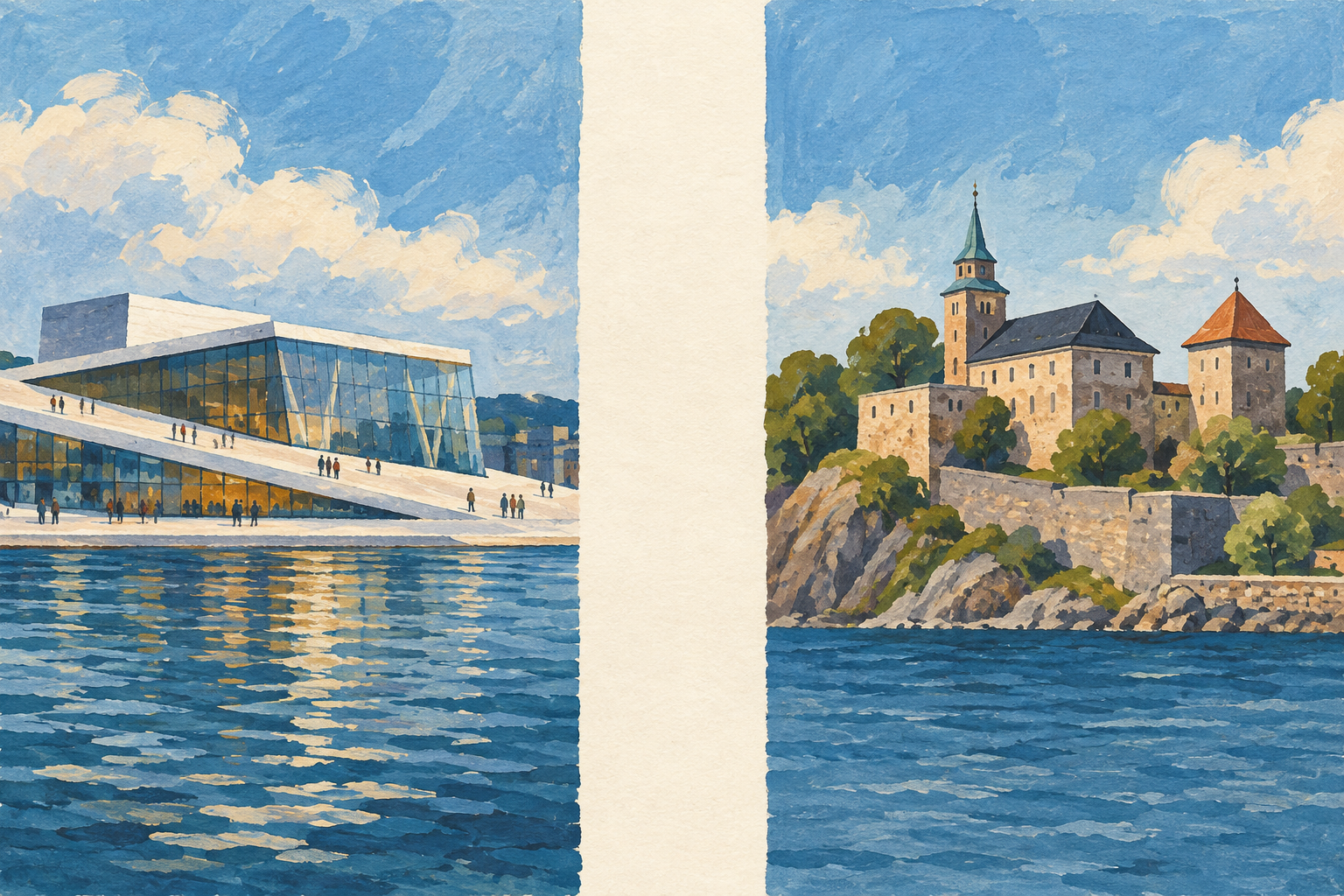
Start at Oslo Opera House in Bjørvika. Snøhetta's design turned the roof into urban space open to the public: walking its slopes forms part of experiencing the building. Notice the white marble and glazed volume before continuing. Appreciating the architecture appears in the official free-attractions guide; performances and guided tours have their own conditions.
Then enter Deichman Bjørvika at Anne-Cath. Vestlys plass 1. The library brings together reading spaces, art installations and fjord views from the top floor, and houses the Future Library project. It is a good sheltered break between the Opera and historic centre.
Check library hours for your date. If the weather calls for less outdoor walking, spend more time at Deichman and leave Akershus for another day, preserving the outing's start in Bjørvika.

The Opera's roof forms part of the Bjørvika outing and brings architecture into the city walk.
Photo: Hans Olav Lien · CC BY-SA 4.0 · 2015 · image resized.
Still on day 1: Kvadraturen and Akershus's free grounds
From Bjørvika, follow Kvadraturen's streets towards Akershus. The neighbourhood brings together historic buildings, galleries and museums, changing the scenery after the morning's contemporary architecture. Here the suggestion is to explore the streets without feeling obliged to add another admission.
Finish in Akershus Fortress's grounds, a complex with more than seven centuries of history. Entry to this area is free, but the castle, museums, concerts and other activities have separate conditions. Walking the outdoor complex already gives the visit a specific purpose.
For October–April, the operator lists the main gate as open 6:00–21:00 and side gates 7:00–18:00. Use these hours to plan when to leave and confirm any changes shortly before your visit.
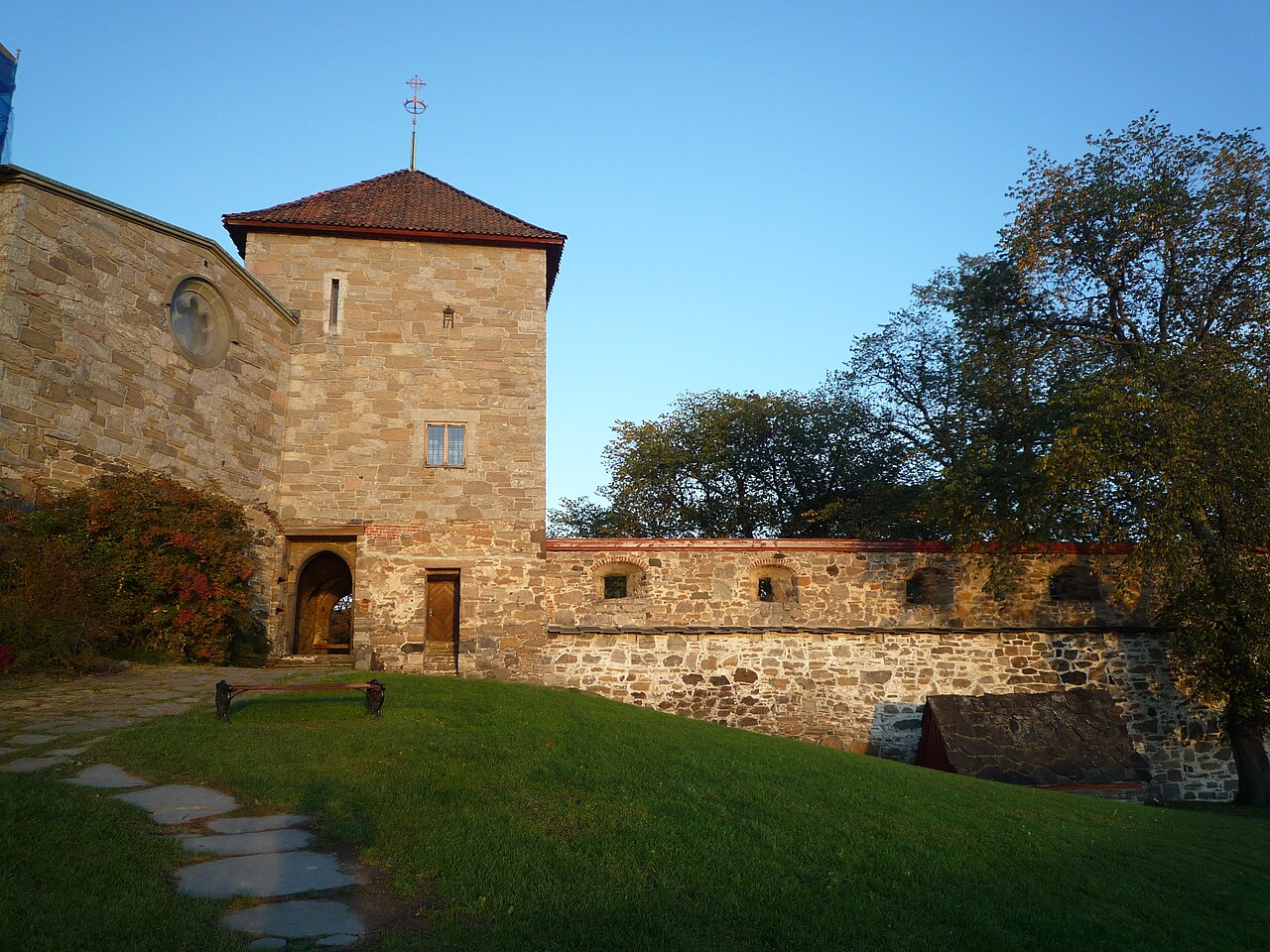
At Akershus, allow time to explore the outdoor complex, which has free access.
Photo: Макс Вальтер · CC BY-SA 3.0 · 2010 · image resized.
Day 2: choose your exploration of art or architecture
Reserve the first part of day two for Nasjonalmuseet, the National Museum, at Brynjulf Bulls plass 3. The collection combines art and design by Norwegian and international artists. For visitors wanting Munch, the page highlights The Scream from 1893 and Madonna from 1894: good starting points when deciding what to seek in the galleries.
If your interest is in buildings and their designs, the alternative is the National Museum – Architecture at Bankplassen 3. It presents drawings, photographs and models in a building combining work by Christian Heinrich Grosch and Sverre Fehn.
You can choose one venue or combine both on the same day using the regular-ticket rule. My suggestion is to include both only if architecture is a priority, leaving less time for the waterfront. For September–December 2026, the National Museum lists Tuesday–Sunday opening; change the days' order if necessary.
After the museum, walk from Aker Brygge to Tjuvholmen
After the National Museum, follow Aker Brygge's waterfront and cross the bridge to Tjuvholmen. The sequence extends the day's theme: you leave exhibition rooms and encounter galleries, art installations and sculptures in the harbour area.
The walk's destination is the sculpture park beside Astrup Fearnley, included in the official free-attractions guide. Entering the museum is a different visit with its own conditions; that admission is not necessary to enjoy the park.
If you visited both National Museum venues, shorten the waterfront walk, keeping Aker Brygge and the sculpture park as reference points. The idea is to finish with a walk, without feeling you have to buy a ticket for every museum along the way.
Day 3: Vigeland sculptures and a walk through the palace park
Start day three at Vigeland Park in the Frogner area. The institution confirms that the park is free and always open. Set aside the morning to follow its paths and observe the sculptures; you can enjoy this outing without buying a museum ticket.
To reach the area, the museum page indicates tram 12 or bus 20; check the current route from your accommodation in Ruter. To explore further, include the Vigeland Museum at Nobels gate 32. It charges admission and, outside summer, lists Tuesday–Sunday opening from 12:00 to 16:00.
Then continue to Slottsparken, the park surrounding the Royal Palace, with trees, ponds and sculptures, including works by Gustav Vigeland. Continue to Karl Johans gate to finish the outing. In late October, keep to the main park: Queen's Park's seasonal opening runs from 18 May to 1 October. Visiting the palace interior is not part of this sequence.
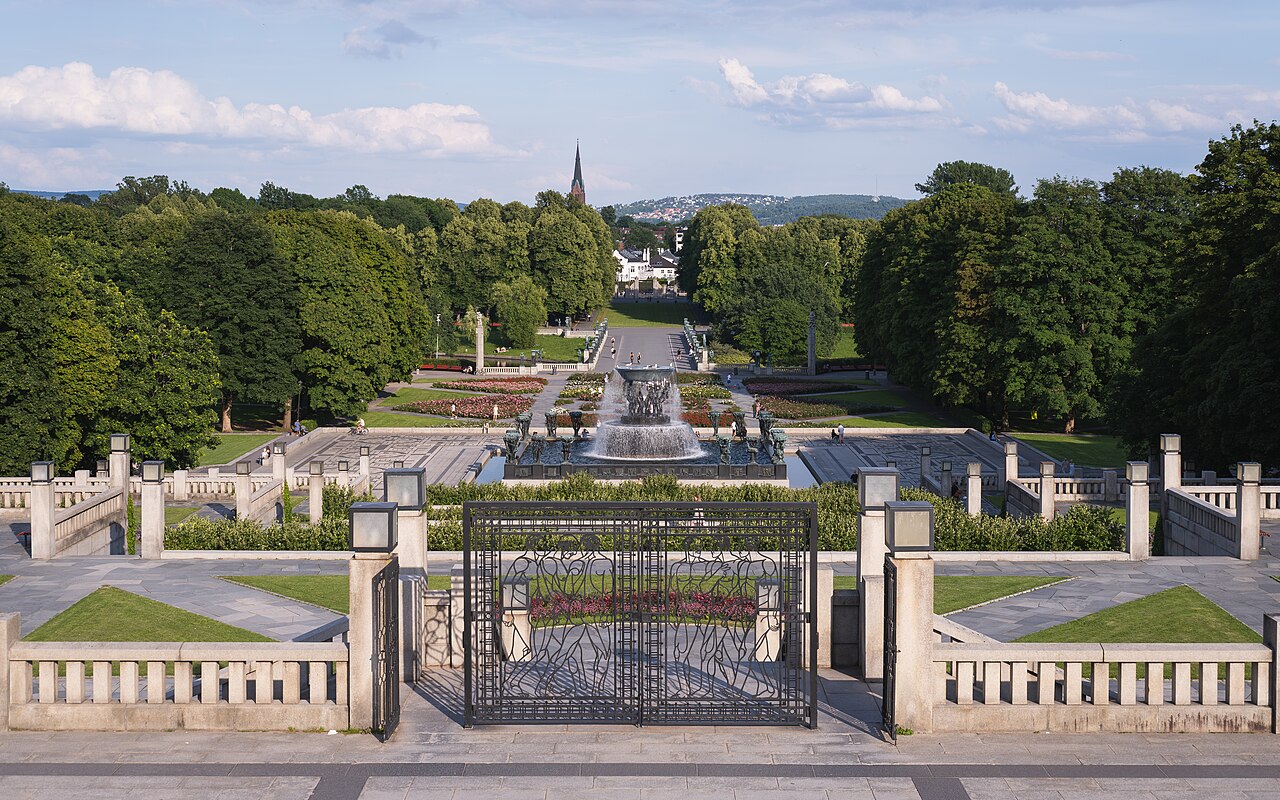
The fountain, sculptures and paths help organise the Vigeland Park visit; this photograph's vegetation is from summer.
Photo: Christian David · CC BY-SA 4.0 · 2024 · image resized.
Day 4: the Botanical Garden, with a rainy-day alternative
Begin day four in Tøyen at the Botanical Garden, beside Sars’ gate and Monrads gate. Garden entry is free. The arboretum and architecture of the Palm House and Victoria House greenhouses provide specific reference points; Victoria House is the greenhouse shown in this section's photograph.
Between 1 October 2026 and 31 March 2027, listed garden hours are 7:00–17:00. Greenhouse interior access must be checked separately, because general hours do not confirm each greenhouse's opening.
If it rains, the alternative within the same complex is the Natural History Museum, with zoology, fossils, minerals and the Climate House. Exhibitions are not free; for October 2026–March 2027, listed opening is Tuesday–Sunday, 10:00–17:00. In that case, replace some walking with the museum and shorten the Akerselva stretch planned for the afternoon.
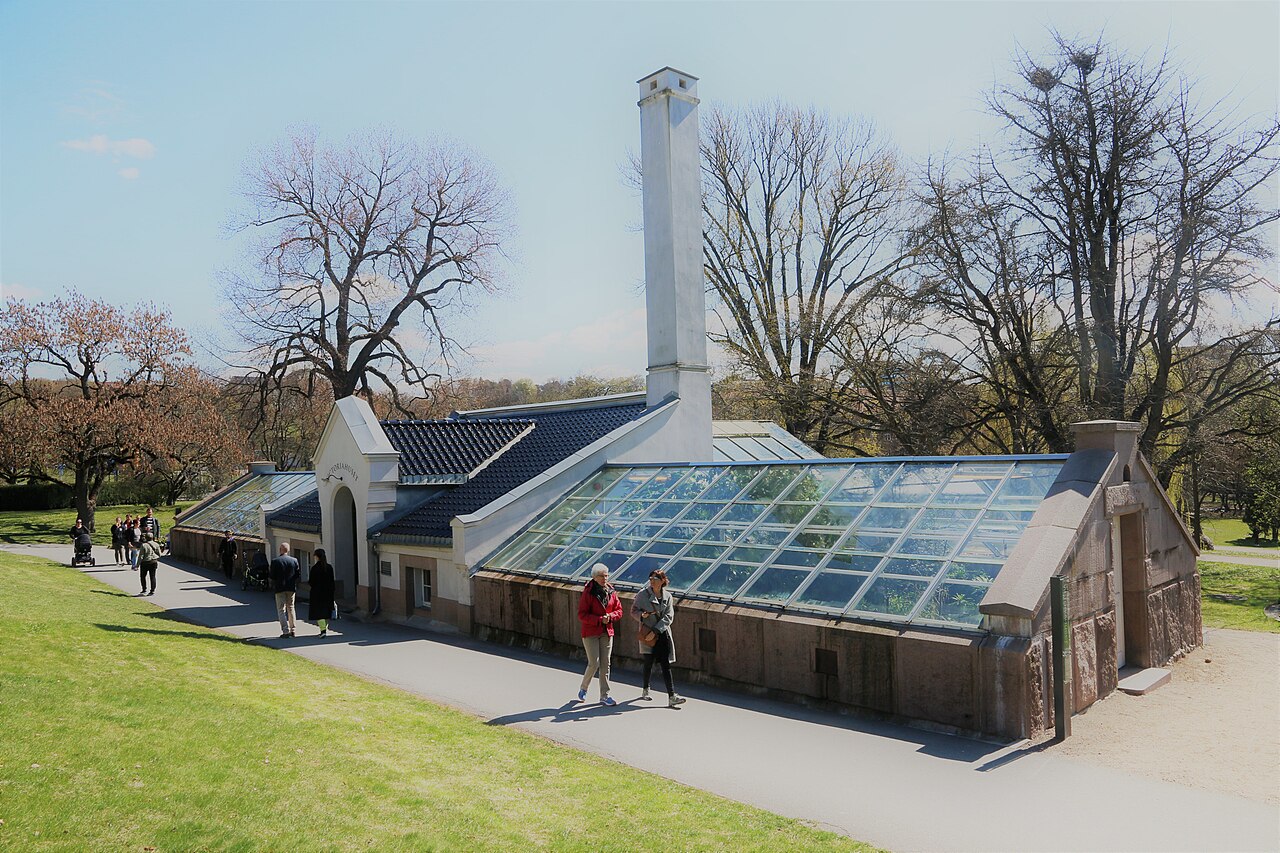
Victoria House forms part of the Botanical Garden landscape; interior access must be checked separately.
Photo: Øyvind Holmstad · CC BY-SA 4.0 · 2017 · image resized.
Lunch at Mathallen and a walk to Mølla waterfall
After Tøyen, continue to Grünerløkka and take a lunch break at Mathallen, Vulkan 5. The market combines specialist shops, cafés and restaurants, letting you inspect menus before deciding. Variety is the reason for choosing it; there is no evidence that it is a cheap option.
For a light meal, I suggest Refresh, a business in the market whose page lists juices, smoothies and toast made with sourdough bread. Check the menu available that day. Mathallen lists opening hours of Tuesday–Saturday, 10:00–20:00, and Sunday, 11:00–18:00, with closure on Mondays; individual businesses may have different hours.
After eating, walk upstream beside Akerselva from Vulkan towards Mølla waterfall and Beierbrua, beside Hønse-Lovisas hus. Bridges, former factories and the waterfall give you plenty to see along the route. The stretch beside the falls goes uphill.
This outing covers part of the river, whose full route is approximately eight kilometres between Maridalsvannet and the fjord. You do not need to do it all: if you included the Natural History Museum in the morning, you can finish the afternoon around Vulkan and Grünerløkka.
In late October 2026, an evening of Oslo World
If your four days overlap 27 October–1 November 2026, consider an Oslo World evening. The music and cultural activities festival with international connections appears in the official calendar and has dates confirmed by its organiser. It is a way to add music to a trip between museums and parks.
A specific choice for dance-music fans is the evening of 30 October 2026 at Jaeger: the official programme announces a Quantic DJ set, g-HA & Olanskii and Platina Rosa. My suggestion is to combine the evening with the Aker Brygge and Tjuvholmen day, leaving a break between the walk and event.
Check hours, entry conditions and availability through the festival before rearranging the day. The events calendar was consulted on 16 October 2026 and does not represent every city event; this programme applies only to the stated dates.
Turn the itinerary into a checklist and budget
Before completing purchases, mark which paid visits remain in your itinerary: the National Museum or Architecture venue, Vigeland Museum and Natural History Museum are choices based on interest, not an obligatory list. Then check which days involve transport and compare ticket types. This order helps prevent purchases for outings you ultimately left out.
Once you have made your choices, use the Viajandar tools in the related links to plan your packing and budget. If accommodation remains undecided, compare two scenarios using prices you researched: the centre and Grünerløkka/Vulkan, including planned journeys in each.
- In Mala Inteligente, turn the chosen sequence into a checklist for walking days, museums and any festival evening.
- In the calculator, use your own figures in Brazilian reais for accommodation, food, transport and admissions. Treat the result as an editable estimate.
- Do not use the calculator's reference figures as Oslo prices: the tool does not provide exchange rates or international quotes.
Which option suits you?
| Option | A good fit if… | What to consider |
|---|---|---|
| Accommodation near Oslo S or in Kvadraturen | Travellers arriving by train who want to begin with the Opera, Bjørvika and historic centre. | The location is convenient for this itinerary, but lower nightly rates have not been established. Compare the exact address and total accommodation cost. |
| Accommodation in Grünerløkka or Vulkan | Travellers who prefer cafés, restaurants and Akerselva walks as neighbourhood reference points. | It particularly suits day four. Check Ruter connections to Oslo S, Vigeland and the waterfront. |
| Separate admissions and transport tickets according to use | Travellers planning plenty of walking and a small museum selection. | You pay for chosen visits, but must add up journeys before deciding between single tickets and longer validity periods. |
| Oslo Pass | Travellers who have assembled enough paid visits and journeys within their intended validity period. | Compare the current price and each attraction's coverage. This itinerary's free outings alone do not justify the purchase. |
| National Museum | Travellers wanting a broad art and design visit, including Munch works. | Reserve a generous part of the day. The regular ticket also allows a same-day visit to the National Museum – Architecture, according to the rule consulted. |
| National Museum – Architecture | Travellers who prefer drawings, models and the building itself as the visit's subject. | A separate ticket is available. You can visit it instead of the National Museum, without feeling obliged to fit in both venues. |
Your itinerary, ready to save
Day 1 — Bjørvika and the historic centre
Begin with the Opera's architecture and public roof, enter Deichman Bjørvika and follow Kvadraturen's streets to Akershus's grounds. Free fortress access refers to the outdoor area.
Prefer an alternative? To reduce outdoor walking, spend more time at Deichman Bjørvika and save Akershus for another day. Check library hours before setting out.Day 2 — National Museum and waterfront
Devote the first part of the day to the National Museum. Afterwards, walk along Aker Brygge's waterfront, cross the bridge to Tjuvholmen and finish at the free sculpture park.
Prefer an alternative? If architecture is your priority, replace the National Museum with the National Museum – Architecture at Bankplassen 3, then continue to Aker Brygge and Tjuvholmen.Day 3 — Vigeland, Slottsparken and Karl Johans gate
Check Ruter to reach the Frogner area and explore Vigeland Park. Then continue to the Royal Palace's main park and Karl Johans gate. In October, leave Queen's Park out of the programme.
Prefer an alternative? To explore the sculptures further, include the Vigeland Museum at Nobels gate 32 and shorten the Slottsparken walk. This is a paid visit, with shorter hours outside summer.Day 4 — Tøyen, Grünerløkka and Akerselva
Begin at the Botanical Garden, continue to Grünerløkka and have lunch at Mathallen, Vulkan 5. Refresh is a light-meal option. Afterwards, walk upstream to Mølla waterfall and Beierbrua without trying to complete Akerselva's eight kilometres.
Prefer an alternative? In rain, replace part of the Botanical Garden and the walk to Beierbrua with the Natural History Museum's paid exhibitions. Keep Mathallen as the food stop on a day when it opens.Before you go
- Count four complete sightseeing days and organise arrival and departure separately.
- Check your accommodation address in Ruter and compare connections with Oslo S, Vigeland and Vulkan.
- For Gardermoen, confirm operator, zones and ticket validity: Oslo's zone 1 is insufficient for the airport.
- Before buying Oslo Pass, add only admissions and journeys you intend to use and check current coverage.
- Schedule the National Museum, Vigeland Museum, Natural History Museum and Mathallen for days other than Monday, according to the opening hours consulted.
- Confirm Deichman and Botanical Garden greenhouse hours; garden hours do not guarantee greenhouse access.
- In late October, visit the Royal Palace's main park and leave Queen's Park out of the outing.
- Check Mathallen businesses' menus and hours before fixing the food break.
- If travelling between 27 October and 1 November 2026, check Oslo World programming and tickets.
- Review opening hours, ticket coverage and events shortly before your trip; the information was consulted on 16 October 2026.
Questions to help you decide
Where should I stay in Oslo for car-free sightseeing?
For this itinerary, my suggestion is to begin searching around Oslo S and Kvadraturen: these bases suit train arrival and day one. Grünerløkka and Vulkan make sense if cafés, restaurants and Akerselva walks weigh more heavily in your choice. Sources do not establish lower rates in any of these areas.
Is Oslo Pass worth it for four days?
Not automatically. Add chosen admissions and transport needed during the validity period considered. Vigeland, the Botanical Garden, Akershus's grounds and Tjuvholmen's sculpture park already offer free outings. Also check whether each intended museum is included under current conditions.
Can I leave Gardermoen without using Flytoget?
Yes. Regular Vy trains run between Gardermoen and Oslo S. Flytoget is a separate service. Oslo Pass coverage consulted includes local Vy trains on that route but excludes Flytoget. Check your pass or ticket validity before boarding.
Which outings in this itinerary are free?
Akershus's grounds, Vigeland Park, the Botanical Garden and Tjuvholmen's sculpture park are confirmed free. The Opera's architecture and Mølla waterfall also appear in the official free-attractions guide. This does not extend free entry to the castle, museums, performances or guided tours.
How can I rearrange the itinerary if it includes a Monday?
Use Monday for the Opera, Deichman, Kvadraturen and Akershus day or the outdoor Vigeland and Slottsparken outing. Confirm library hours. According to the opening hours consulted for this period, the National Museum, Vigeland Museum and Natural History Museum open Tuesday–Sunday; Mathallen closes on Mondays.
Do the four days include arrival and departure?
These are four full sightseeing days in Oslo as part of a longer trip, with arrival and departure counted separately. The selection combines the centre, waterfront, art, parks and neighbourhoods; it does not try to cover the whole city or represent an entire trip through Norway.
Ready to start planning?
Turn walking and museum days into a checklist in Mala Inteligente ↗Organise an estimate in Brazilian reais in the calculator using your own figures ↗A preview of your next trip
See the destination on video, then return to the itinerary to plan your trip at your own pace. Video in Portuguese.
Sources and editorial review
This is a researched guide, not a personal account of a visit. The itinerary suggestions are editorial recommendations. Confirm opening arrangements, prices and conditions close to your trip.
- VisitOSLO — transport between Gardermoen and Oslo · checked 2026-10-16
- VisitOSLO — getting around, tickets and zones · checked 2026-10-16
- VisitOSLO — Oslo Pass transport coverage · checked 2026-10-16
- VisitOSLO — Oslo centre and Kvadraturen · checked 2026-10-16
- VisitOSLO — Grünerløkka · checked 2026-10-16
- Oslo Opera House — architecture and public spaces · checked 2026-10-16
- VisitOSLO — Deichman Bjørvika library · checked 2026-10-16
- Forsvarsbygg — visiting Akershus Fortress · checked 2026-10-16
- VisitOSLO — National Museum · checked 2026-10-16
- VisitOSLO — National Museum – Architecture · checked 2026-10-16
- Vigeland Museum — museum and park visitor information · checked 2026-10-16
- VisitOSLO — Slottsparken · checked 2026-10-16
- VisitOSLO — Oslo Botanical Garden · checked 2026-10-16
- VisitOSLO — Natural History Museum and free garden access · checked 2026-10-16
- VisitOSLO — Akerselva walk · checked 2026-10-16
- Mathallen Oslo — location and opening hours · checked 2026-10-16
- Mathallen Oslo — Refresh · checked 2026-10-16
- VisitOSLO — official 2026 events calendar · checked 2026-10-16
- Oslo World — organisation and 2026 dates · checked 2026-10-16
- Oslo World — 2026 programme at Jaeger · checked 2026-10-16
- VisitOSLO — free attractions · checked 2026-10-16
- VisitOSLO — Aker Brygge and Tjuvholmen · checked 2026-10-16