Spain · Seville (Sevilla), Andalusia, Spain
Five days in Seville in late 2026: palaces, gardens, flamenco and leisurely meals
Spend five full days in Seville exploring the Alcázar, Cathedral, gardens, Triana, flamenco and museums, with leisurely meals and the 2026 Feria del Belén.
GETTING STARTED
Visit the Alcázar and Cathedral on separate days, devote a day to the gardens and another to Triana, and finish with the Museum of Fine Arts and Casa de Pilatos. The itinerary includes flamenco, a pastry stop, a contemporary Andalusian meal and the Feria del Belén for visits up to 22 December 2026. These are five full days, excluding arrival and departure.
Who it is for: Brazilians visiting Seville for the first time, with five full days of sightseeing excluding arrival and departure, who are interested in heritage, gardens, ceramics, flamenco and leisurely food stops.Five days organised by area, with room to rest
You can combine Seville's major monuments with gardens, ceramics, flamenco and a leisurely meal without putting everything into the same day. The suggestion is to divide the five days by area: the Alcázar and Santa Cruz; the Cathedral and Salvador; Plaza de España and Parque de María Luisa; Triana; and, finally, the Museum of Fine Arts and Casa de Pilatos. This gives you a change of focus throughout the trip and keeps every break from competing with another attraction.
We are talking about five full days of sightseeing, excluding arrival and departure. This is a city itinerary for a first visit to Seville, which can also fit into a longer trip through Andalusia. The numbering makes it easier to follow: change the order to accommodate bookings, Sunday visits to the Cathedral and museum opening days.
When choosing where to stay, first consider how the location fits these routes. Santa Cruz is convenient for starting at the Alcázar and walking around the neighbourhood; Triana works well for ceramics, the market and Calle Betis, but requires river crossings on the days spent in the centre. If you like returning to your room before going out in the evening, check your accommodation's exact address in relation to your main outing, rather than relying only on the neighbourhood name.
If you arrive at the airport, TUSSAM's EA bus route is an option to consider. The official map consulted connects the airport with Plaza de Armas and shows stops at Santa Justa, San Bernardo, Prado de San Sebastián and Paseo Colón/Torre del Oro. Choose a stop according to your accommodation and check the current service: the map is dated 2024, so we do not use its fares or frequencies as current information.
Day 1: the Alcázar, Santa Cruz and an evening of flamenco
Start at the Real Alcázar and set aside the morning for the palace and its gardens. The official website describes it as a royal palace still in use and a World Heritage Site since 1987. Allow time to take in its spaces before changing pace in the gardens; save the Cathedral for another day so it does not share this first morning.
For late 2026, the official winter information consulted lists opening hours of 9:30 am to 5 pm from October to March. Choose your time slot when booking and check the conditions for your date. Do not use the later time when visitors are required to leave as a guide for when to arrive.
After a break for something to eat, continue along Callejón del Agua and through Santa Cruz. The municipal guide supports combining these walks with the monument complex. The appeal of this sequence is leaving a ticketed attraction and continuing on foot through the neighbourhood, without scheduling another monument immediately afterwards.
To end the day, we suggest a performance at the Museo del Baile Flamenco Cristina Hoyos, at Calle Manuel Rojas Marcos, 3. The museum itself confirms performances featuring dance, singing and guitar; the page consulted advertises Puro Flamenco as a one-hour show. Choose an available performance for your date and leave a break between Santa Cruz and the show, including time to return to your accommodation if that helps.
If you prefer to finish sightseeing earlier, visit the interactive exhibition at the Museo del Baile Flamenco during the day. It offers another way to explore the subject, but does not replace the experience of watching a live performance. Choose according to your interests, without making both activities feel compulsory.
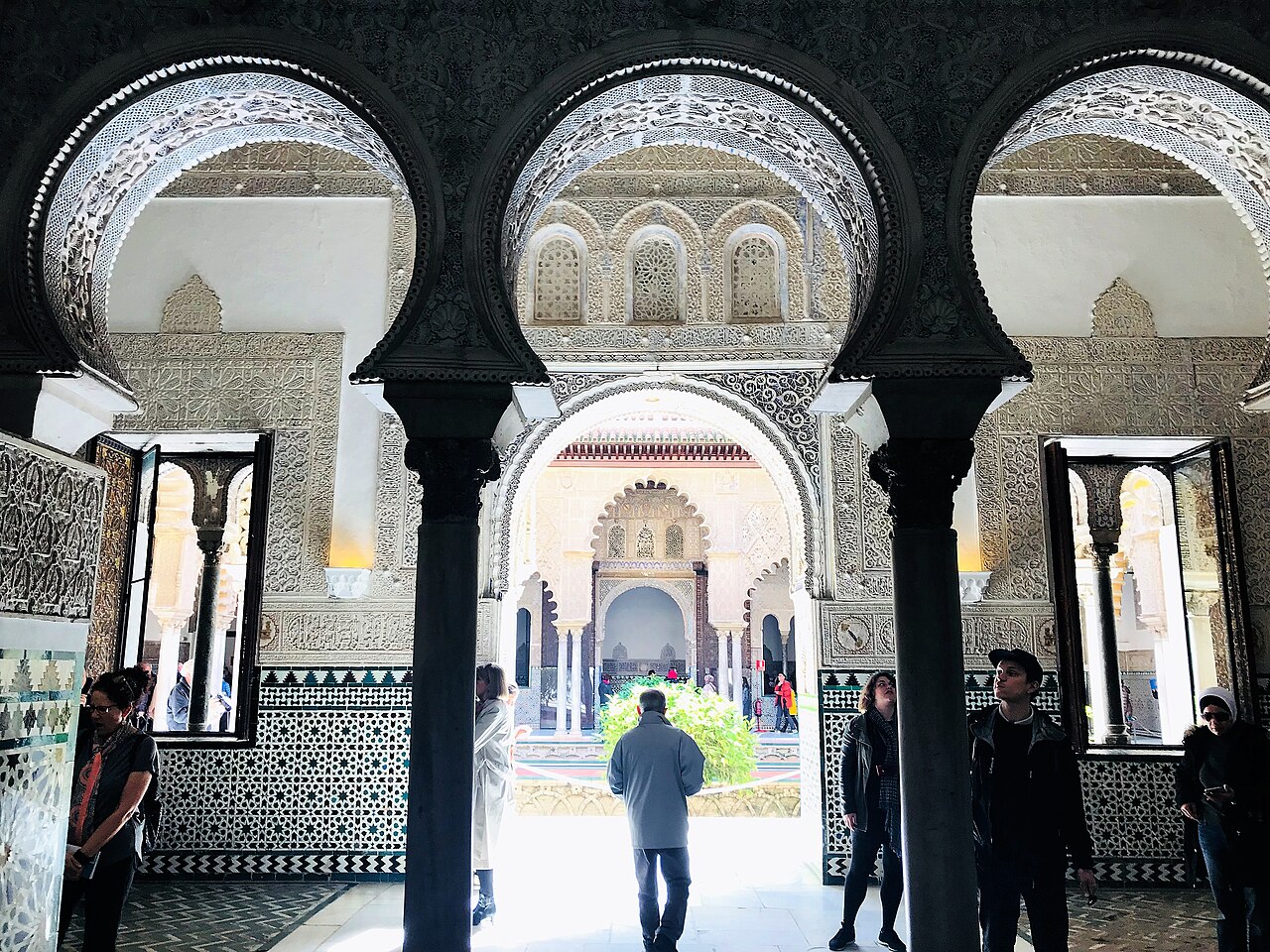
On your Alcázar day, leave time to take in the interiors before continuing through the gardens.
Photo: Mervat · CC BY-SA 4.0 · 2018 · image resized.Photo source and license
Source: https://commons.wikimedia.org/wiki/File:Alcazar_of_Seville.jpgLicense: https://creativecommons.org/licenses/by-sa/4.0
Image processing: Miniatura de 1280 px do Wikimedia Commons; sem alteração de conteúdo.
Day 2: the Cathedral, Salvador and a nativity scene fair along the way
Give the Cathedral a morning of its own. The general visit option consulted combines the Cathedral and Giralda and includes admission to the Church of the Salvador. You can include the tower or focus on the church interior: you do not need to climb the Giralda to make the visit worthwhile. Entry is timed, and the tower has separate access controls.
After your visit, take a lunch break and walk around the area surrounding the General Archive of the Indies. In this itinerary, it forms part of the outdoor route; we have not set aside time to go inside without sufficient practical information. Continue to the Church of the Salvador, checking beforehand how to use your ticket and when you can enter.
If your trip falls between 7 November and 22 December 2026, add the Feria del Belén on Calle Fray Ceferino González, beside the Cathedral and the General Archive of the Indies. Seville's official events calendar confirms the dates and classifies the fair as a craft event. It fits naturally into the route as a chance to discover the tradition of nativity scenes, even if you do not intend to buy anything. The listing consulted does not provide detailed opening hours.
If this outing falls on a Sunday, reverse the order. When checked on 17 November 2026, the Cathedral listed cultural visiting hours of 2:30 pm to 7 pm on Sundays, and 10:45 am to 6 pm from Monday to Saturday. Do the outdoor route first and leave the Cathedral for the afternoon; fit Salvador around its confirmed opening hours. Religious services may affect access.
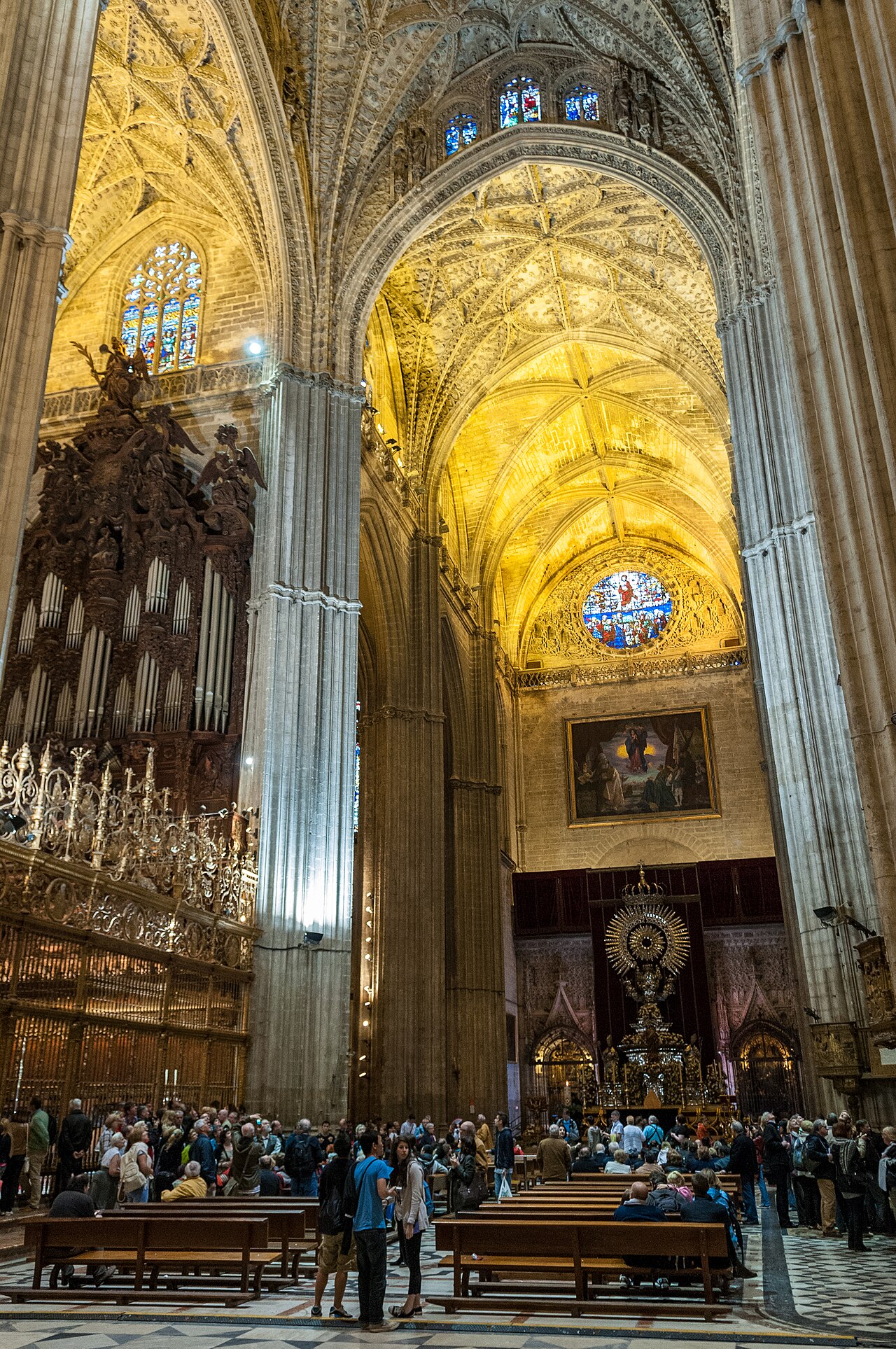
The Cathedral deserves its own time in the itinerary, even if you decide not to climb the Giralda.
Photo: Michal Osmenda from Brussels, Belgium · CC BY 2.0 · 2012 · image resized.Photo source and license
Source: https://commons.wikimedia.org/wiki/File:Seville_Cathedral_(6931808712).jpgLicense: https://creativecommons.org/licenses/by/2.0
Image processing: Miniatura de 1280 px do Wikimedia Commons; sem alteração de conteúdo.
Day 3: Plaza de España, gardens and folk culture
After two days of palaces and churches, begin the morning at Plaza de España. According to the official municipal guide, Aníbal González designed it for the 1929 Ibero-American Exhibition as part of Parque de María Luisa. Take in the square as a whole before moving on: it deserves more than a photo stop.
Continue through Parque de María Luisa and use this stretch to slow down. We suggest alternating walking with seated breaks, keeping the morning free of another timed booking. After something to eat, continue to Plaza de América, still following the plan of exploring this area.
In the Mudéjar Pavilion, the Museum of Arts and Popular Customs adds ceramics and ethnological heritage to the outing. It is a good way to connect the monumental setting with objects and cultural practices, while also breaking up your time outdoors. Confirm that it will be open on your date; the Archaeological Museum, listed as closed in the guide consulted, is not included as an indoor visit.
If the forecast suggests rain that would disrupt the walk, swap this day with the morning at the Museum of Fine Arts and the stop at La Campana. Save Plaza de España and the park for a more favourable spell of weather. This preserves the garden outing, instead of having you walk through just to complete the itinerary.
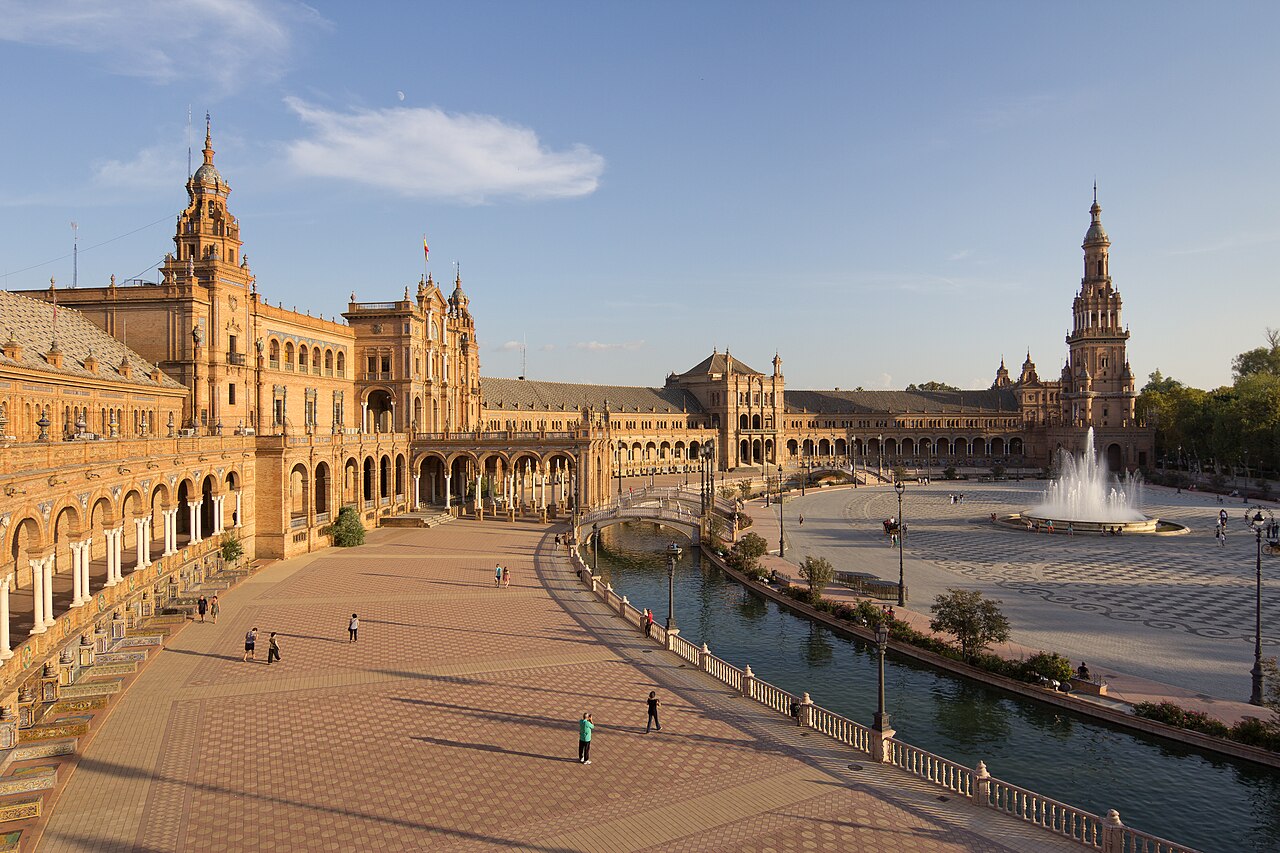
Start at Plaza de España, then extend the outing through Parque de María Luisa.
Photo: Carlos Delgado · CC BY-SA 4.0 · 2014 · image resized.Photo source and license
Source: https://commons.wikimedia.org/wiki/File:Plaza_de_Espa%C3%B1a_(Sevilla)_-_01.jpgLicense: https://creativecommons.org/licenses/by-sa/4.0
Image processing: Miniatura de 1280 px do Wikimedia Commons; sem alteração de conteúdo.
Day 4: getting to know Triana, from ceramics to the table
Cross the Isabel II Bridge, also known as Triana Bridge, and start at Plaza del Altozano. Then head to Centro Cerámica Triana, at Calle Callao, 16, on the corner of Antillano Campos. This order gives the outing context: you learn about ceramic production before continuing through the market and the neighbourhood streets.
According to ICAS, the centre occupies the former Cerámica Santa Ana premises and displays kilns, industrial spaces, materials and audiovisual resources about ceramic production. The collection also includes pieces from different periods. This is a visit for understanding processes and uses, as well as looking at finished objects.
Plan Triana for a day between Tuesday and Sunday. The practical information page consulted lists opening hours of 10 am to 8 pm, with last admission at 7 pm, and closure on 25 December, among other special dates. It also states that admission is free on presentation of a general Alcázar admission ticket, excluding reduced-rate tickets. Keep your ticket and confirm the conditions before visiting.
Continue through Mercado de Triana and then along Calle Betis. The market is included as part of a walk through the neighbourhood, with no promise of finding a particular stall or meal. For a sit-down break at an establishment whose details have been checked, the suggestion is Abades Triana, at Calle Betis, 69.
The current Abades website describes contemporary Andalusian cuisine, a location on the banks of the Guadalquivir opposite the Torre del Oro, and a dining room with a panoramic window. Allow time for the meal and check the menu, service and booking arrangements for your date; a table by the window is not guaranteed. If you choose dinner, you can visit the ceramics centre and market earlier, rest, and return to Calle Betis at the end of the day.
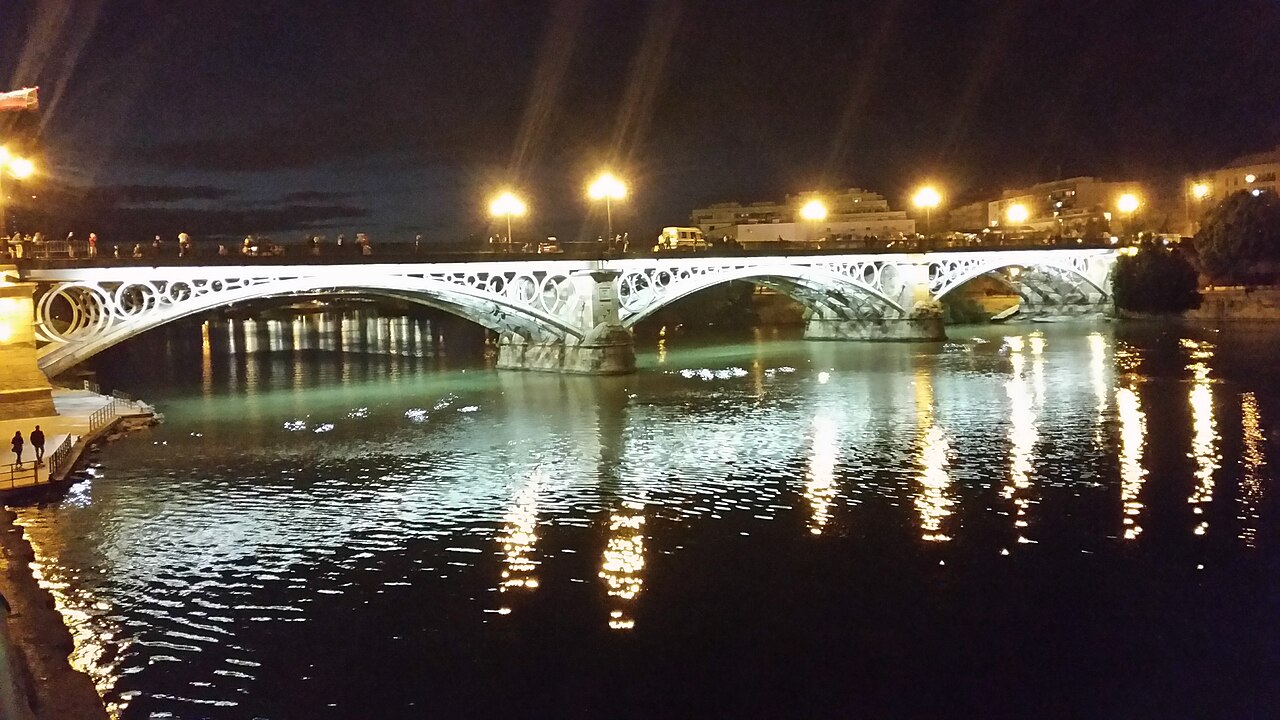
The Isabel II Bridge connects to Triana; this night-time photograph accompanies a day that can end with dinner on Calle Betis.
Photo: Daniel GB · CC BY 2.0 · 2016 · image resized.Photo source and license
Source: https://commons.wikimedia.org/wiki/File:Puente_de_Triana_(Sevilla)._(27284292282).jpgLicense: https://creativecommons.org/licenses/by/2.0
Image processing: Miniatura de 1280 px do Wikimedia Commons; sem alteração de conteúdo.
Day 5: painting, pastries and Casa de Pilatos
Begin the fifth day at the Museum of Fine Arts, at Plaza del Museo, 9. The municipal guide highlights Sevillian Baroque paintings by Zurbarán, Murillo and Valdés Leal, as well as 19th-century Andalusian painting. After the monuments and ceramics, the visit offers a different encounter with the city's artistic output.
You do not need to try to give everything equal attention. As a suggestion for pacing the visit, choose the works and rooms that most spark your curiosity and leave room for the next break. The guide confirms the collection and location, but not access to every room; check the visitor arrangements for your intended day.
Continue to Confitería La Campana, at Calle Sierpes, 1–3. The establishment itself describes its current work as an artisan confectioner and states that it was founded in 1885. The recommendation is also supported by its current products and services page, not just its history. This is a stop to choose a sweet treat between the museum and the next visit, depending on what is available that day; keep lunch as a separate meal if you need to.
In the afternoon, visit Casa de Pilatos, at Plaza de Pilatos, 1. The official guide documents its Renaissance transformations and visitor access. It closes the itinerary with a return to palace architecture, after you have discovered other sides of Seville. You can also bring it forward to replace a long walk on a rainy day, bearing in mind that the complex includes courtyards.
If painting is not among your interests, the exhibition at the Museo del Baile Flamenco is a specific alternative for the morning, especially if you only saw the performance on the first day. In that case, keep Casa de Pilatos as the afternoon visit and fit in La Campana only if the stop works with your route.
How to adjust the order without missing the sights
The main adjustment for the end of the year concerns the calendar. The sequence works best when you start with activities that require bookings and known closures, leaving the park, squares and walks to fill out the days. Around Christmas, confirm each attraction's arrangements for the exact date, without automatically applying the hours of an ordinary week.
The municipal events calendar was consulted on 17 November 2026 and listed the Feria del Belén with dates relevant to the city-centre route. This confirmation applies to the fair and the stated period; it does not support announcing other activities or concluding that there will be no events after it.
To keep the trip comfortable, protect the break before flamenco and the time set aside for your meal in Triana. If getting around starts to feel tiring, use transport between your accommodation and the area you are visiting that day. You do not need to measure the success of your trip by the number of kilometres walked.
- First, fit the Alcázar, Cathedral and flamenco performance into the available dates; then arrange the walks around them.
- Set aside a day for Triana when Centro Cerámica is open, and check arrangements for your meal at Abades separately.
- Use the Museum of Fine Arts, Casa de Pilatos and the exhibition at the Museo del Baile Flamenco to rearrange your sightseeing according to your interests and the weather.
- If your trip takes place after 22 December 2026, remove the Feria del Belén from this sequence.
From itinerary to checklist and cost estimate
Once you have chosen your dates, use Mala Inteligente to turn the itinerary into a checklist: keep tickets and bookings accessible, choose footwear for the walking days, and decide what to pack after checking the forecast for your trip. Include the general Alcázar admission ticket among the documents to keep, because of the admission condition stated by Centro Cerámica Triana.
In Viajandar's cost calculator, put together an estimate in Brazilian reais with separate fields for accommodation, transport, attractions and food. For Seville, use amounts you have researched and converted using an exchange-rate reference consulted separately. The calculator does not provide international exchange rates, and its reference amounts should not be treated as local prices.
Give the performance and the meal at Abades their own attention when filling in the budget, as they are specific choices in this itinerary. This selection does not provide prices or table and ticket availability for any particular date. The next step is to check your dates and adjust the amounts, keeping the stop at La Campana and your daily meals in the total.
Which option suits you?
| Option | A good fit if… | What to consider |
|---|---|---|
| Stay in Santa Cruz | You want to start with the monuments and return to your accommodation to rest before flamenco. | It is convenient for the start of the itinerary; the Triana day requires crossing to the other side of the river. Check your accommodation's exact location. |
| Stay in Triana | You want to devote more time to ceramics, Calle Betis and the meal at Abades Triana. | It works well for the fourth day, but adds river crossings when sightseeing in the monumental city centre. |
| Cathedral with the Giralda | You want to explore the Cathedral interior and also include the tower. | The Giralda has separate access controls. Leave room in your schedule for the visit so that Salvador does not feel rushed afterwards. |
| Cathedral without climbing the Giralda | You prefer to focus the day on the Cathedral interior, the area around the General Archive of the Indies and the Church of the Salvador. | You forgo the tower and gain a less crowded afternoon schedule; climbing it is not a requirement for enjoying the Cathedral. |
| Performance at the Museo del Baile Flamenco | You want to watch dance, singing and guitar at the end of a day of sightseeing. | You need to choose a performance for your date. The museum exhibition is a daytime alternative offering a different experience. |
| Abades Triana on your day in the neighbourhood | You want to sit down for a leisurely meal of contemporary Andalusian cuisine. | Allow time and check the dining arrangements; this selection provides neither a price quote nor a guarantee of a table by the window. |
Your itinerary, ready to save
Day 1 — the Alcázar, Santa Cruz and flamenco
Set aside the morning for the Real Alcázar and its gardens. After a break for something to eat, walk along Callejón del Agua and through Santa Cruz. Take a break at your accommodation before heading to the Museo del Baile Flamenco, at Calle Manuel Rojas Marcos, 3, for a performance chosen in advance.
Prefer an alternative? If you prefer a daytime activity, visit the exhibition at the Museo del Baile Flamenco after Santa Cruz and leave the performance out of that day.Day 2 — the Cathedral, the area around the General Archive of the Indies and Salvador
Visit the Cathedral in the morning, including the Giralda if you wish. After lunch, walk around the area surrounding the General Archive of the Indies and continue to the Church of the Salvador. Between 7 November and 22 December 2026, add the Feria del Belén on Calle Fray Ceferino González.
Prefer an alternative? If the day falls on a Sunday, schedule the Cathedral for the afternoon. First, walk around the area surrounding the General Archive of the Indies and, up to 22 December 2026, through the Feria del Belén; fit Salvador around the church's confirmed opening hours.Day 3 — Plaza de España and Parque de María Luisa
Start at Plaza de España and continue through Parque de María Luisa, leaving time to sit down between stretches of walking. After your lunch break, head to Plaza de América and visit the Museum of Arts and Popular Customs in the Mudéjar Pavilion, subject to its confirmed opening arrangements for the date.
Prefer an alternative? If rain disrupts the park outing, bring forward the Museum of Fine Arts and the stop at La Campana planned for the fifth day. Move Plaza de España and Parque de María Luisa to a more favourable weather window.Day 4 — Triana, ceramics and a riverside meal
Cross the Isabel II Bridge, pass through Plaza del Altozano and visit Centro Cerámica Triana, at Calle Callao, 16. Continue through Mercado de Triana and along Calle Betis. Fit in a leisurely meal at Abades Triana, at number 69 Calle Betis, according to the service available on your date.
Prefer an alternative? If Centro Cerámica is closed, swap the entire day with the Plaza de España outing. If your meal at Abades is in the evening, visit Mercado de Triana and the ceramics centre first, take a break, and return to Calle Betis before dinner.Day 5 — Fine Arts, La Campana and Casa de Pilatos
Spend the morning at the Museum of Fine Arts, at Plaza del Museo, 9. Continue to La Campana, at Calle Sierpes, 1–3, for a pastry break, without treating it as a compulsory substitute for lunch. In the afternoon, visit Casa de Pilatos, at Plaza de Pilatos, 1.
Prefer an alternative? If you prefer dance to painting or the Museum of Fine Arts is unavailable, visit the exhibition at the Museo del Baile Flamenco. Keep Casa de Pilatos for the afternoon and fit in La Campana as a break, without feeling obliged to visit all three places.Before you go
- Choose your five sightseeing days before buying tickets: arrival and departure are excluded from this count.
- Check the official Alcázar booking system for your preferred date. The winter information verified on 17 November 2026 lists hours of 9:30 am to 5 pm; do not interpret the later time when visitors must leave as permission to enter.
- Check your Cathedral time slot and any changes due to worship. At the time of the research, cultural visits on Sundays were only available in the afternoon.
- Check the conditions for accessing the Giralda and using the Cathedral ticket at the Church of the Salvador.
- Schedule Centro Cerámica Triana between Tuesday and Sunday and check special opening hours. The page consulted lists closures on 25 December, 1 January and 6 January.
- Keep your general Alcázar admission ticket: the information consulted allows it to be presented for free admission to Centro Cerámica Triana, excluding reduced-rate tickets. Confirm the current conditions.
- Confirm the opening hours of the Museum of Fine Arts, Casa de Pilatos and the Museum of Arts and Popular Customs. The guide supports these visits, but does not guarantee that every room will be open on your date.
- Choose a currently listed performance at the Museo del Baile Flamenco; do not use offers identified as valid in 2025 to plan for 2026.
- Check service, menu and booking arrangements at Abades Triana and La Campana's opening arrangements for your intended day. No prices or availability have been verified for this selection.
- Include the Feria del Belén only if your visit takes place on or before 22 December 2026, and confirm its opening hours, which were absent from the listing consulted.
- Check the current EA bus service with TUSSAM. The map used to identify stops is dated September 2024 and does not substantiate current fares or frequencies.
- Turn the sequence into a checklist in Mala Inteligente and use the calculator only for an editable estimate in Brazilian reais, converting expenses in euros separately.
Questions to help you decide
Do the five days include arrival and departure?
These are five full days of sightseeing, excluding arrival and departure. The itinerary focuses on part of urban Seville and can form part of a longer trip through Andalusia; it does not aim to fit the entire region into those days.
Is it better to visit the Alcázar and Cathedral on the same day?
The suggestion here is to separate them: the Alcázar and gardens on the first day; the Cathedral and surrounding area on the second. This lets you walk through Santa Cruz after the palace and visit the Church of the Salvador after the Cathedral without turning everything into a rush.
Does the Cathedral ticket include the Church of the Salvador?
The general visit option consulted combines the Cathedral and Giralda and includes admission to the Church of the Salvador. Entry is timed, and the Giralda has separate access controls; confirm the conditions that apply to your date and to using the ticket at Salvador.
How can I fit in Centro Cerámica Triana?
Swap the Triana day with another day in the itinerary. The practical information consulted lists Centro Cerámica Triana as open from Tuesday to Sunday and closed on 25 December. Do not leave this visit dependent on a Monday.
Are any events confirmed for late 2026?
The municipal events calendar consulted confirms the Feria del Belén from 7 November to 22 December 2026, beside the Cathedral and the General Archive of the Indies. For a trip after 22 December, remove this stop; the research does not support concluding that there will be no other events.
Which visits can help me rearrange the itinerary if it rains?
Casa de Pilatos, the Museum of Fine Arts, Centro Cerámica Triana and the exhibition at the Museo del Baile Flamenco give you options for rearranging the days. Casa de Pilatos combines architecture and courtyards, so it is not a visit entirely sheltered from the rain. Check each attraction's visitor arrangements before making the swap.
How should I use the Viajandar calculator for this trip?
Use the calculator to organise an estimate in Brazilian reais with editable amounts. For expenses in euros, enter amounts you have converted using an exchange-rate reference consulted separately. The tool does not provide international exchange rates, and its reference amounts do not represent Seville prices.
Ready to start planning?
Mala Inteligente: turn your five days of sightseeing into a travel checklist ↗Cost calculator: organise your estimate in Brazilian reais with editable amounts ↗Sources and editorial review
This is a researched guide, not a personal account of a visit. The itinerary suggestions are editorial recommendations. Confirm opening arrangements, prices and conditions close to your trip.
- Visita Sevilla — official guide to sightseeing by area · checked 2026-11-17
- Real Alcázar — preparing for your visit · checked 2026-11-17
- Seville Cathedral — cultural visit · checked 2026-11-17
- Visita Sevilla — monuments and museums · checked 2026-11-17
- TUSSAM — official airport bus route map · checked 2026-11-17
- ICAS — Centro Cerámica Triana · checked 2026-11-17
- ICAS — practical information for Centro Cerámica Triana · checked 2026-11-17
- Abades Triana — restaurant and location · checked 2026-11-17
- Confitería La Campana — official website · checked 2026-11-17
- Museo del Baile Flamenco — museum and performances · checked 2026-11-17
- Visita Sevilla — official events calendar · checked 2026-11-17
- Visita Sevilla — Feria del Belén 2026 · checked 2026-11-17